Frontline engagement, innovation and service redesign
5.29 Innovation and service redesign will be critical in order to achieve improvements in the quality and efficiency of public services in more challenging economic circumstances. Often the people with the best ideas for service improvement and innovation are on the frontline, close to service users. There are already good examples of better engagement with these staff but these examples need to become the norm if the kind of radical innovation needed to deliver higher quality with less resource is to be achieved. Public services are already responding to this challenge, increasing staff satisfaction and commitment by adopting techniques developed in both the public and private sector to tap into ideas and expertise from the frontline.
5.30 Policy makers are increasingly aware of the need to use frontline insight to develop practical policy. Recently published research commissioned by the Cabinet Office and carried out by the Sunningdale Institute again makes the case for a Whitehall policy culture that seeks out, captures and values frontline insights and experiences in order to ensure policies that are practical, effective and relevant.7 Government will issue a response to this report shortly and has said that it will ask Departments to establish better ways of engaging with the expertise of those working at the frontline.8 This workstrand has also looked at ways to encourage this engagement. Box 5.C highlights examples of transferable approaches that organizations throughout the public sector should aim to emulate.
| Box 5.C: Using frontline expertise to redesign and develop services Make It Work: Sunderland City Council's Northern Way Worklessness Pilot engaged with over 280 employers, practitioners and clients and used service design methods to map the public services needed to help disadvantaged individuals out of unemployment. The resulting combined framework allowed services to be commissioned more efficiently by designing out elements that did not meet users' needs. WIBGI: The NHS National Innovation Centre has pioneered the use of 'Wouldn't It Be Good If…?' (WIBGI) sessions to facilitate and stimulate collaboration between frontline staff, patients, policy makers, commissioners and industry. The sessions, themed around specific challenges such as reducing waiting lists or healthcare-associated infections, use creative techniques to answer needs identified by frontline staff, stimulate intelligent demand within the NHS and focus suppliers' product development. GEMS: GEMS is the Ministry of Defence-wide scheme, launched in 1996, that recognises and rewards staff ideas that are put into practice. The scheme encourages all civilian and armed forces personnel, ex-employees, contractors and their staff to contribute constructive ideas for improving efficiency and organisation anywhere within the Department, and recognises the value of their contribution with a financial reward. The scheme gathers some 2000 ideas each year, generating, on average, £10 million in savings a year. Drive for Change: Drive for Change, a practical tool to help with change management, was developed by the Cabinet Office and Trades Union Congress (TUC) under the umbrella of the Public Services Forum (PSF), which brings together government, public service employers and trade unions. Drive for Change encourages employers, staff and trade unions to work together to innovate by tapping into staff knowledge and experience, to build a shared vision for improvement and to deliver joint solutions. Productive Series: The NHS Institute for Innovation and Improvement is building on the success of the Productive Ward, which enabled nurses to identify for themselves how to release time for patient care, by further developing a Productive Series focusing on productive community hospitals, mental health wards, and leadership. Further programmes, aimed at operating theatres and community services, are currently in development. |
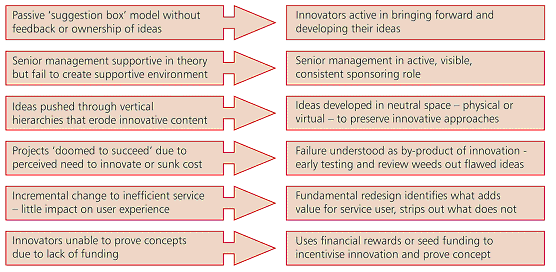
5.31 The schemes highlighted in Box 5.C demonstrate that there is a body of good practice in the public sector. However, a recent NAO report9 found that fewer than 60 per cent of bodies surveyed had even reached the point of encouraging staff to submit innovative ideas. While adopting an 'off the shelf' approach to engagement and improvement - developed and proved elsewhere - might be appropriate in some circumstances, organisations throughout the delivery chain should feel empowered to adapt schemes, refining their chosen model to suit their needs and designing their own solutions. Box 5.D highlights the kind of shifts necessary if the engagement of frontline staff is to be meaningful.
| Box 5.D: Moving toward stronger frontline engagement
Source: HM Treasury |
5.32 Continuous improvement tools such as Lean10 have also been used both to harness staff insight and expertise and identify the redundant or avoidable steps that can be stripped out of delivery chains, leading to more efficient services. Box 5.E shows several examples of this across government.
5.33 Public service organisations that are introducing ongoing cycles of continuous improvement, often based on the Lean approach, are improving cost effectiveness, quality of services, timeliness of services and are engaging more successfully with their workforce. The Cabinet Office's Capability Building Programme has begun the work of joining up departmental efforts, but these tools should be used more systematically across the whole public sector and there is already a clear case for more coordinated action:
• there are numerous and diverse examples of continuous improvement in public services, based on Lean principles, which have delivered substantial improvements;
• continuous improvement driven from the frontline is both effective, sustainable and comparably inexpensive;
• awareness and experience of this approach among leaders is varied;
• organisations are facing similar challenges and increasingly using similar approaches to make a difference, but are at different stages of development; and
• more can be done to spread existing expertise and learning between organisations and offer opportunities to collaborate across services.
| Box 5.E: Continuous improvement in departments Police service: Operation QUEST is a Home Office sponsored programme focused on operational process improvement and capability development that taps into the experience of frontline officers, reviewing end-to-end processes, analysing associated data and changing the way operational work is carried out. Successes include a 72 per cent reduction in the number of apology calls made in Brighton and Hove and projected net officer time savings worth more than £1 million a year in Norfolk from more effective deployment decisions. HM Revenue and Customs: PaceSetter is one of the key ways in which HM Revenue and Customs will continually improve the performance of its business. A phased rollout will help HMRC take a fresh look at business processes from a customer perspective, introducing a new discipline of how to manage these processes and involving everyone in finding ways to improve. Primarily implemented in large processing areas so far, productivity increases of at least 30 per cent have been achieved in areas where PaceSetter is operational. Local government: The National Process Improvement Project (NPIP), sponsored by the Department for Communities and Local Government, allowed a group of local authorities to deploy industry standard business improvement methods across 10 service areas, from child protection to waste management. These projects used a variety of process analysis and costing techniques to help identify ways to deliver efficiency gains of up to 12 per cent and service improvements across different service areas and types of local authority. Department for Work and Pensions: DWP established the Lean Way in 2007 as an ambitious four-year programme to embed continuous improvement using Lean behaviours and techniques rolled out in a phased approach supported by a DWP Lean Academy. In addition to improved customer and staff experience, improvements to processes identified and designed by staff have been rolled out nationally, and efficiency gains delivered to date per site range between 18 and 30 per cent. The programme has already achieved savings of over £10 million a year and expects further savings in excess of £40 million. |
| Recommendation 5.4: Use continuous improvement tools such as Lean more systematically across the public sector, and develop capacity to examine themes that cut across organisational boundaries: • continuous improvement approaches should be used more systematically across the public sector. Departments should be expected to have in place comprehensive programmes of employee engagement, which mirror the elements of the successful continuous improvement and Lean programmes; • Cabinet Office and HM Treasury should accelerate work towards developing a centre of excellence in this field, drawing in public service staff with relevant expertise to examine themes that cut across organisational boundaries, identifying the bureaucratic burdens and barriers identified by these approaches, and coordinating action to address them; and • future Capability Reviews should take account of departmental arrangements for employee engagement when assessing a department's capacity to innovate. (See recommendation 5.7.) |
5.34 Government also needs to build the public sector's understanding of the importance of good design in delivering effective public services and build the appropriate skills to turn this understanding into tangible improvements. In partnership with the Department for Innovation, Universities and Skills (DIUS), the Design Council11 is trialling a design-led innovation programme for the public sector, based on their successful Designing Demand model in the private sector, to give managers the skills to understand better how design can improve efficiency and service outcomes. DIUS and the Design Council should take this programme, Public Services by Design, forward as a matter of priority.
5.35 Alongside improving service design, greater innovation should be encouraged throughout the public sector. Since the publication of the Innovation Nation white paper,12 DIUS have worked with a range of partners to develop interventions to promote public service innovation. This includes NESTA's 13 development of The Lab, which aims to provide the freedom, capital and the expertise to help undertake radical experiments to improve public services in the face of serious economic and social challenges. 14
5.36 Departments are also acting to develop their innovative capacity. The Department of Health, as part of High Quality Care for All,15 has developed a programme of work to support and enable the NHS and its partners to realise the benefits of innovation while improving procurement processes and, ultimately, health outcomes. This will be achieved through harnessing the energy and ideas of the frontline in a rewarding format, better information, innovation funds and prizes, a new legal duty for Strategic Health Authorities to promote innovation and better links between research, teaching and education, healthcare delivery and wider industry.
5.37 The NHS National Innovation Centre has also developed a suite of online tools - The Key - which it has made available to all public sector organisations. These tools identify needs, support innovative responses from suppliers and the frontline and promote the diffusion and adoption of transferable ideas by showcasing them. The Key is being developed in partnership with the Department of Health, DIUS and DWP for wider application in central government, but The Key could also benefit local government. The Beacons scheme in local government is to be replaced with a new award and knowledge transfer scheme that should make use of appropriate online tools such as The Key to spread innovation and best practice among LSPs.
5.38 Challenge funds and prizes can also trigger innovations, rather than recognise them once they have taken place, and are another example of tools that parts of the public sector are already exploiting.16 Challenge prizes prompt involvement from new audiences, help to identify barriers to innovation, recognise successful innovation, and have a positive effect on the total amount of effort and investment that is channelled into solving some of the most challenging and complex problems that public services face. As drivers for more efficient, innovative and engaged local authorities, Regional Improvement and Efficiency Partnerships (RIEPs) should consider using this approach to address cross-cutting issues at a local level.
5.39 Accountability and measurability of innovation are hugely important, given the investment that is being channelled into developing public sector innovation. The NAO's recent report recognised that better measurement of innovation would help organisations to make a stronger case for investing in innovation amid competing priorities. 17 Having accurate information is key to both large and small projects so that benefits or shortcomings can be demonstrated and meaningful lessons learned for the future. NESTA are working to develop a UK Innovation Index 18 that will help public sector organisations to understand their performance relative to others (and to the private sector) and make a substantial contribution to improving the current measurement gap. 19 It is vital that the public sector component of this work, though complex, should produce simple, credible metrics and not be allowed to fall behind schedule.
| Recommendation 5.5: Programmes to improve design and innovation in public services should be accelerated, with a consistent method of measuring investment and benefits: • DIUS should support the Design Council to accelerate the planned roll out of the Public Services By Design programme by increasing the number of prototype projects. Central and local government should consider how design approaches could help deliver improved outcomes and greater efficiency; • innovation should be recognised and diffused by developing and applying the suite of tools available through The Key model to other public services. DIUS, the NHS National Innovation Centre, IDeA and CLG should explore using this model as part of the planned renewal of the local government Beacons scheme; • as drivers for more efficient, innovative and engaged local authorities, Regional Improvement and Efficiency Partnerships (RIEPs) should consider using challenge prizes to address cross-cutting issues at a local level; and • departments should contribute to the development of NESTA's Innovation Index, to improve the measurement of investment in, and benefits from, public sector innovation, with implementation of a pilot index by the end of 2009. |
5.40 A series of joint HM Treasury and DIUS workshops on the theme of innovation among frontline staff identified the importance of recognising the achievement of those who do innovate. In the 2008 Pre-Budget Report, the Government announced that it would sponsor a new efficiency award for frontline public servants who have reformed public services and delivered greater value for money. This award, highlighting frontline engagement and its role in delivering the Operational Efficiency Programme's recommendations, will be part of the Guardian's Public Services Awards in 2009.
_______________________________________________________________________________________
7 Engagement and Aspiration: Reconnecting policy making with front-line professionals, Sunningdale Institute/Cabinet Office, March 2009.
8 Working Together: Public services on your side, Cabinet Office, March 2009.
9 Innovation across central government, NAO, 2009.
10 Developed by Toyota, Lean is an improvement approach that aims to reduce waste in the production process by focusing on areas where activities consume resources but do not add value from the customer's perspective. For an examination of Lean's applicability in the public sector, see Evaluation of the Lean approach to business management and its use in the public sector, University of Warwick, March 2006
11 Sir Michael Bichard is currently Chairman of the Design Council, an executive NDPB that is sponsored by DIUS. DIUS and the Department for Culture, Media and Sport are jointly responsible for the organisation.
12 Innovation Nation, DIUS, March 2008.
13 National Endowment for Science, Technology and the Arts.
14 See online at www.nesta.org.uk/the-lab-innovating-public-services.
15 High quality care for all: NHS Next Stage Review final report, Department of Health, June 2008.
16 For example, Home Office, Design Council and the Design and Technology Alliance have engaged young victims of crime, police, mobile industry experts and designers to understand current and future issues regarding mobile phone crime. Working with the Technology Strategy Board, they have launched a £400,000 challenge to design solutions that make mobile phone handsets and the data stored on them harder or less desirable to steal and make future mobile commerce transactions secure and fraud proof. The Department of Health is introducing Health Innovation Challenge Prizes to address some of the major healthcare challenges facing the NHS and Strategic Health Authorities, targeting resource at helping frontline staff develop, grow and spread new ideas to deliver real improvements in the quality of care people receive. The Sainsbury Review recognised the Ministry of Defence leading best practice through running a Grand Challenge and Competition of Ideas to stimulate innovation in its Science and Technology programme.
17 Innovation across central government, National Audit Office, March 2009.
18 More information is available online at www.innovationindex.org.uk
19 Departments have also begun to develop their own tools - for example, the Department of Health is currently developing a suite of metrics to measure the impact of innovation in the NHS.