Time delays and price increases are not highly correlated
50 Of those projects delayed by more than six months, 35 per cent also experienced price increases. Of all the projects experiencing delays, 43 per cent were delivered over the originally contracted price and 57 per cent were completed to the contracted price. This suggests that in many cases, there is some evidence that the intended risk transfer is working. In the cases where delay has only been as a result of those risks retained by the private sector, the public sector has not seen the price of their project increase, as a result of the delay.
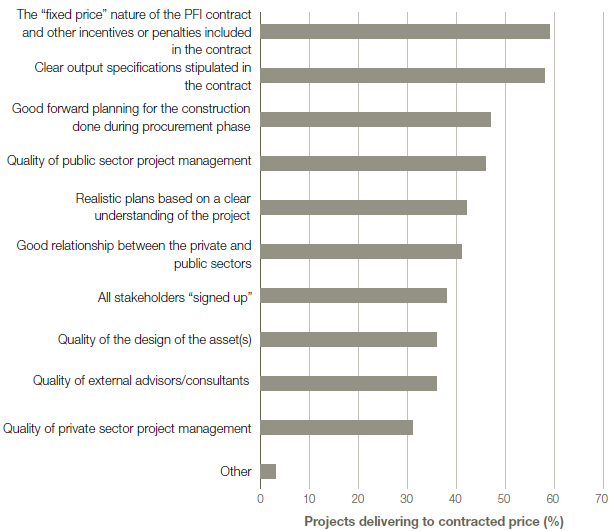
Figure 10 |
Reasons for delivery to contracted price |
|
Source: National Audit Office |
NOTE |
1 Statistics are based on 59 respondents. |
51 One project manager commented: "So PFI, from a purely financial point of view, worked very well delivering the assets because the risks on all these projects lies with the private sector, or in terms of it being managed better, that was the private sector's risk again… we got the facilities we wanted for the money quoted ultimately".
52 For delayed projects that have seen prices increase, this has either been because the risks causing delays were borne by the public sector, or there were a range of factors causing the delay holding both parties responsible for price increases.