A large majority of PFI projects received good quality ratings from project teams and key users
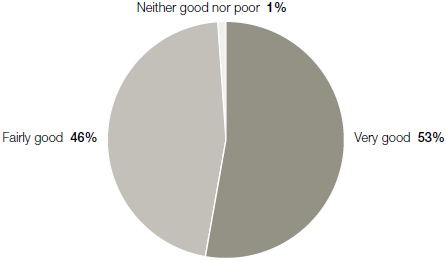
73 PFI projects generally received very high quality ratings from those who worked on them. Ninety nine per cent of respondents reported project teams gave good quality ratings to completed projects and nearly half rated them as very good (Figure 14). It must be noted that a number of survey respondents did not provide an answer to questions about quality and environmental ratings, and therefore we cannot be sure the answers presented here are representative of the entire sample.
74 In 2003, all the project teams rated the design quality and construction quality as adequate or better. Seventy two per cent (of 32 respondents) rated the design quality to be good or very good. Sixty nine per cent rating the construction quality to be good or very good, with 22 per cent rating it as very good. Project teams in 2008 therefore appear to be as satisfied, if not more so, with the quality of their buildings than they were in 2003.
Figure 14 |
Quality ratings by project teams |
|
Source: National Audit Office |
NOTE |
1 Statistics are based on 70 respondents (44 additional 2008 respondents were unable to provide these data). |
75 Some interviewees from projects undertaken in the early years of PFI mentioned that post completion quality reviews were rather informal in nature. They stated that since this time, the importance of ensuring quality has been recognised and is consequently taken very seriously now. Project managers from the schools sector felt that it was because of this commitment to quality that Buildings Schools for the Future has incorporated the need to ensure that buildings are transformational and make a difference to the standards of service provision.
76 Several of the in-depth interviews with project teams indicated that there were sometimes issues with minor defects that did not substantially affect building use but needed attention. While projects were often completed and became operational on time, some of these issues took years to resolve satisfactorily. One project manager commented: "We did identify a number of snags9 …part of that is because although you have a performance mechanism, that's more about the delivery of the services rather than anything that's outstanding from the construction phase. I'm not talking about major snags, relatively minor ones but a lot of them, and it took three years before we substantially knocked off most of the snags".
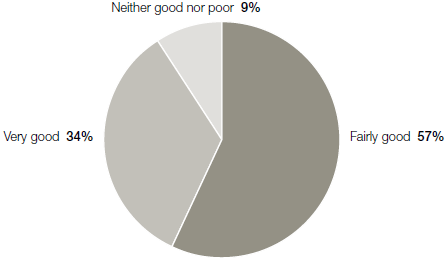
77 Ninety one per cent of PFI projects were rated as very or fairly good by the key users. No projects were rated as poor (Figure 15).
Figure 15 |
Quality ratings by key users |
|
Source: National Audit Office |
NOTE |
1 Statistics are based on 58 respondents (56 additional 2008 respondents were unable to provide these data). |
_________________________________________________________________________________
9 The term 'snags' refers to minor defects that did not substantially affect building use but needed attention.