Student motivation
What effect does rebuilding schools have on unauthorised absence?
It is often suggested that rebuilding a school improves student motivation, leading to improved educational outcomes.
In our analysis we have used unauthorised absence as a proxy for student motivation. The presumption is that more motivated students are less likely to play truant, resulting in
reduced unauthorised absence. Graph 2 shows unauthorised absence in the two types of schools. There are 29 conventional schools and 52 PFI schools in the dataset. The illustration is for three years before and the two years after re-opening. The unit shown is the pp. departure from the average level of unauthorised absence across England.
Graph 2: Unauthorised absence in rebuilt schools relative to England average
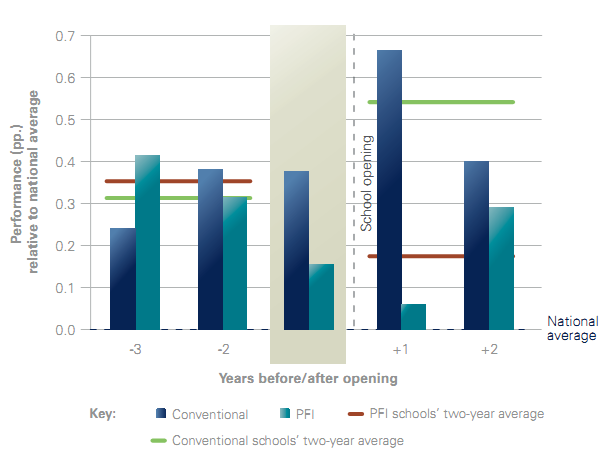

The England average rate of reduction in unauthorised absence is 0.03 pp. year-on-year. Both Graph 2 (below) and Table 2 (overleaf) show that using PFI to rebuild schools corresponds to a reduction in unauthorised absence relative to the national average (0.06 pp. per annum) whereas, quite surprisingly, the use of conventional procurement may increase it (0.07 pp. per annum).
Table 2
Unauthorised absence relative to national average(pp.) 29 conventional schools | ||||||
|
| Before | After | |||
Year | 3 | 2 | 1 | +1 | +2 | |
Rebuilt schools | 0.24 | 0.38 | 0.37 | 0.66 | 0.40 | |
Two-year average | 0.31 | excluded | 0.53 | |||
Before v. after improvement | 0.22 |
| ||||
Annual improvement | 0.07 |
| ||||
Annual improvement including national average | 0.10 |
| ||||
Student attainment relative to national average (pp.) 32 conventional schools | ||||||
|
| Before | After | |||
Year | 3 | 2 | 1 | +1 | +2 | |
Rebuilt schools | 0.41 | 0.31 | 0.15 | 0.06 | 0.29 | |
Two-year average | 0.36 | excluded | 0.18 | |||
Before v. after improvement | -0.19 |
| ||||
Annual improvement | -0.06 |
| ||||
Annual improvement including national average | -0.03 |
| ||||