6. Conclusion and way forward
EPEC's review of the initial experience of contracting authorities in Europe with the use of competitive dialogue has highlighted some interesting trends and concerns:
■ All four procurement routes provided for in the Procurement Directive are being used to procure PPPs across the EU. This reflects the fact that PPPs cover a broad range of projects (i.e. from small size facilities with little functional complexity to multi-billions complex projects involving a large array of potential solutions);
■ Multiple factors guide contracting authorities in the choice of the preferred procurement route. Generally, the open and restricted procedures are applied for simpler projects, where a contracting authority can specify all its requirements in advance. As projects become more complex and the need to involve bidders to define an optimal solution grows, contracting authorities tend to choose the more flexible competitive dialogue or negotiated procedures. This may, however, be at the expense of some transparency, as the four procurement procedures imply a "trade-off" between the risk of transparency loss and flexibility, as can be illustrated below:
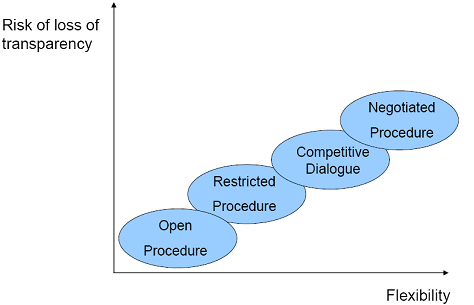
■ Competitive dialogue is intended to provide a procurement method which is both transparent and sufficiently flexible to fit complex projects like PPPs. Although it goes some way in achieving this goal in terms of increased transparency (subject to confidentiality and protection of intellectual property issues), our survey shows that it falls short in terms of flexibility in certain of its key provisions;
■ Whilst competitive dialogue appears to have distinct advantages in the quality and value of projects it is able to deliver, this comes at the expense of significantly increased transaction cost and time;
■ Competitive dialogue does not therefore appear as a "one fits all" solution for PPPs and contracting authorities should be encouraged to take a case by case view on whether competitive dialogue is likely to deliver best results.
EPEC review suggests that there are several ways to capitalise on the strengths of competitive dialogue while mitigating its main drawbacks:
■ Competitive dialogue appears to deliver its best results on issues such as fostering innovation and facilitating a constructive dialogue between the contracting authority and the bidders. This results in solutions that better fit the needs of the contracting authority. This is particularly relevant for complex facilities or buildings (e.g. hospitals, prisons) where functional design and technology are critical to the success of a project but where many means to achieve the goals are available. In such cases the improved outcome which can be expected from the dialogue can potentially offset the increased cost and time derived from the procedure. Competitive dialogue would be suited strongly to projects where such features are important.
Other examples may be found in projects where the financial solution is particularly challenging;
■ As a corollary, projects of (i) repetitive nature, (ii) for which standardised terms and contracts are readily available, (iii) for which design solutions are already well established and proved to be effective and (iv) which have limited opportunity for innovation, may not benefit from the use of competitive dialogue. In such cases, the added cost may not be justified by the potential outcome improvements and the open or restricted procedure would be more suitable;
■ An effective use of the procedure may imply taking more advantage of the flexibility offered in the Procurement Directive by reducing the number of bidders in the successive stages of the dialogue. This can help reduce cost and time as well as allow the contracting authorities to focus on the more responsive proposals.
EPEC review has demonstrated that there is a clear need to strengthen the public sector's awareness and understanding of the competitive dialogue procedure, as well as its ability to cope with the increased demands on qualified staff and financial resources:
■ While it seems inevitable that, to a significant extent, the learning process will take place "on the ground", it is important to develop the preparatory training capabilities of individual procuring institutions. One way to achieve this would be through investing time and effort in the development of in-house procedures on PPP procurements using competitive dialogue;
■ The vast majority of the respondents would welcome additional guidance on the use of the procedure. The professional procurement community in Europe could, in particular, benefit from clarifications on the degree of flexibility in interpreting certain provisions of the Procurement Directive (e.g. the "fine- tuning" and "confirmation of commitments" after selection of the preferred bidder) and on how to best overcome the limitations of competitive dialogue in coping with the current credit crisis;
■ Additional guidance should be given with due regard to the variety of PPP projects and the differences in national laws and regulatory practices across Europe. Most respondents therefore expect any further guidance would come from their national procurement authorities, and / or through advice of their relevant professional bodies, supported in both cases by the European Commission as far as application of the existing rules is concerned, rather than from further regulations at the EU level.