Political support and transparency during the procurement and bidding process is a key factor that attracts private finance
Strong political support is one of the characteristics of procurements that have attracted a wide range of bidders, including leading and experienced players.
In the United Kingdom, the public-private partnership (PPP) concept was launched in the early 1990s with that government's Private Finance Initiative (PFI), but the program initially had limited impact. It was not until 1995-96 that momentum started to build and contracts began to be signed. There was a widely held belief that there would be a change of government in 1997 and that the incoming government would not support the program. However, instead of abandoning the program, the incoming government commissioned a review on how to re-invigorate it. The review recommendations included:
∙ Government departments should set out clear lists of their projects and establish the priority of those projects. The private sector was able to see a clear pipeline of prioritized opportunities, which catalyzed private investment.
∙ Any impediments to the progress of projects, particularly legal ones, should be expeditiously resolved.
∙ Financially and commercially experienced people were needed to support the public authority project teams. An existing taskforce was re-focused to help build up PFI expertise and to start the process of coordinating the initiative across government departments and standardizing the procurement process. Tw o years later, Partnerships UK (PUK)- itself a PPP-was formed. PUK's aim was to provide the public sector with the same level of financial and commercial expertise enjoyed by the private sector.
Case in Point 1: Texas P3 roads program |
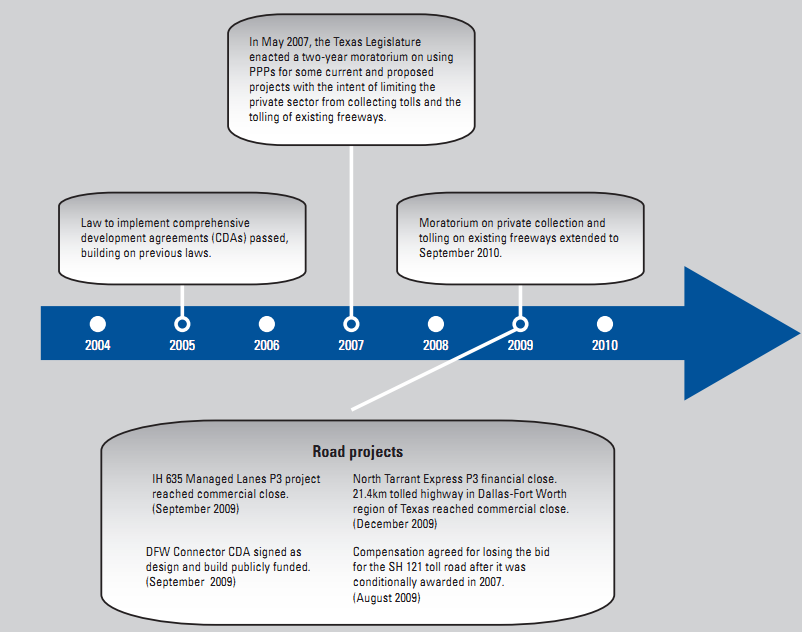
In Texas laws were passed in 2005 to allow public-private partnership (P3) type projects with an expectation that this could be applied to a number of roads projects. But within two years there was a moratorium enacted, which prevented private companies from collecting tolls and the tolling of existing roads. While a small number of projects have proceeded, the scale of the P3 program originally planned has not been achieved. |
|
|
Chapter 2.1, which picks up many of PUK's detailed recommendations, focuses on the benefits of having a program of prioritized opportunities in place. What is relevant here is that the review was a clear statement of the new government's support for the program and a catalyst for renewed investor and lender interest. This led to the signing of more than 600 projects, by September 2009, with a combined capital value of more than £55 billion.1
There are many examples of strong political support acting as a catalyst. For example, India currently has the largest program of PPPs in the world, with its five-year plan (2007-12) estimating an investment need of US$492 billion for roads, railways, ports, and power and water facilities.2 The World Bank is supporting India's program with US$1.2 billion of financing.3 Other examples abound: since the 1980s, Malaysia has completed a number of PPP-based road concessions,4 as did the Chilean government in the 1990s and Singapore in 2004.5
Another factor that attracts private finance is a public, comprehensible and transparent procurement process to determine which contracts will be awarded. If the process is perceived as corrupt or designed to give an advantage to a particular bidder, it will deter others and ultimately undermine the legitimacy of the process. The process itself needs to be conducted in a timely and efficient manner, and bidders will expect the public authorities to have the ability and capacity to do this. One significant challenge of India's current road-building program (which aims to build 7,000 kilometers a year over the next five years) is for the public authorities to have the capacity to handle such a large number of parallel procurements.
In some countries, not all new infrastructure projects involving the private sector are subject to a competitive process and unsolicited bids are accepted. A brief summary of some of the advantages and disadvantages of an unsolicited bid approach is provided in Table 1.
Table 1: Advantages and disadvantages of the unsolicited bid approach
Advantages | Disadvantages |
An unsolicited bid may offer solutions not otherwise available-for example, it may access an alternative land bank. | The approach may be limited in application. For example, because of the extensive land required for new roads, it may not be feasible for them to come to market as unsolicitedbids. |
The procurement process is potentially quicker and cheaper. | The best test for whether a proposal will give value for money is for there to be a comparable competing bid. However, by its nature, an unsolicitedbid will not have the benefit of competitive bidding. |
An unsolicited bid may be a route for furthering local projects that are not national priorities. | An unsolicited bid can potentially undermine the creation of coordinated, prioritized programs. |
| An unsolicited bid provides no assurance that projects will actually proceed-for example, the unsolicited bidder can withdraw their offer. |