Could the regulated price and asset base approach used for utility companies be more widely adopted?
Regulated infrastructure utilities have continued to be successful in issuing bonds in the current economic climate. Should the regulated price and asset base approach that underpins the business model for utilities be adapted for other types of infrastructure, such as those projects more typically employing a concession-based approach? A regulated approach is often applied to existing monopolistic infrastructure networks that may require capital expenditure over a long period and where protecting consumer interests is paramount as consumers have little, if any, choice of supplier. The concession approach is typically used where a single new asset is being developed but the user/consumer can choose whether or not to use/pay for it; ongoing capital expenditure is more for ongoing maintenance rather than wholesale replacement or upgrade.
From the outset, the concession approach provides for significant risk transfer to the private sector, which may result in significant variation in their investment return. While the regulated regime also transfers risk, this risk transfer is largely contained within a regulatory review period. Thus, in some respects, the regulated approach reduces the long-term risk transfer to the owner/operator but also limits their investment return.
In considering whether it might be appropriate to apply the regulated approach to infrastructure more generally, we highlight some possible challenges, for example, in the case of a real toll road and a shadow toll road (see Appendix A.5 for further description).
Figure 8: Subordinated bonds and senior debt tranche
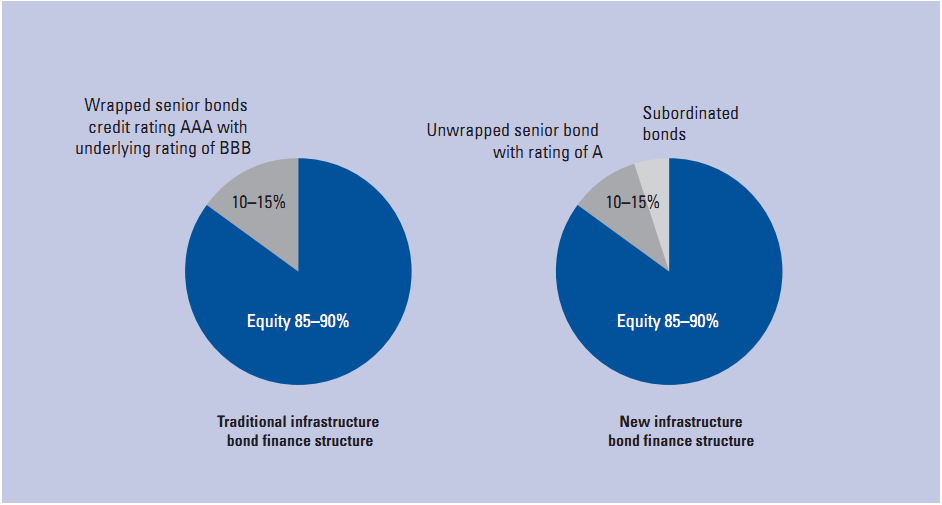
Source: World Economic Forum analysis, based on proposal described by Hadrian's Wall Capital.
Real toll road
Real toll roads are open to competition, and consumers can decide whether or not to use them. The concession structure passes the risk of non-usage to the private-sector party. In such cases, market choice should self-regulate the amount charged to customers. If there is no comparable alternative infrastructure, a regulated approach may be more appropriate.
If the project includes building a new asset, then the concession approach provides for a significant transfer of the construction cost and time risk from the public to the private sector.
Shadow toll road
In circumstances where the government pays the concessionaire for the availability and usage of a road (a shadow toll), the regulated approach has the potential advantage of ensuring that the government pays only for actual operating and maintenance costs, and not for the contingency and risk transfer premiums that will be built into the concessionaire's price. But this regulated approach may well lead to future price increases and create potential budgeting volatility for the public authorities.
In either the case of real toll roads or shadow toll roads, consideration would also need to be given to the cost of implementing the regulatory regime and how it would be applied to what might be a series of fragmented road concessions that represent only a portion of the total road network.