AFFORDABILITY
2.10 While good design will not always result in the lowest initial capital cost, over the period of the contract a higher initial investment can, when expressed as a discounted value, result in the lowest net present cost when account is taken of operational and maintenance savings and the quality of service provided. For design quality to be achieved, the procurer's realistic aspirations must be met while achieving the optimum balance between quality and cost. It is not suggested that good aspirations mean that higher capital costs should be included in the reference project or Public Sector Comparator (PSC). It is essential that the PFI procurement competition be underpinned by realistic affordability assumptions and the avoidance of unjustifiable optimism about the cost of public sector procurement to adequate quality standards (not just relating to the asset, but also to maintenance and to the provision of core services). As has been seen in the past, good design can be sacrificed as bidders desperately seek to fit their costs within a budget that was unrealstic in terms of the initial specifications. If the specifications, once costed realistically, are found to be unaffordable, then they will need to be revised through the benchmark of a realistic reference project until the public sector procurer is confident that the specifications are affordable.
2.11 The procurer, therefore, should make detailed and robust assumptions about the likely cost of the quality of the service being sought. For example, the reference project and PSC must reflect maintenance/replacement costs and time frames (see Section 3 of Treasury Taskforce Technical Note No.5 How to Construct a Public Sector Comparator). The procurer can then use competition to encourage bidders to optimise the overall costs of their proposals to obtain better value for money. The opportunity for increasing demonstrable value will be enhanced if the public sector client welcomes innovation to achieve the required outputs.
2.12 In addition, the procurer must also consider (both in terms of affordability for PFI unitary charges and for the reference project/PSC) the extent to which additional costs should be explicitly budgeted for on the following grounds:
Location or listing: A building in a conservation area or project involving the modernisation of a listed building may be subject to special requirements in terms of materials and the adaptability of existing spaces. The procurer should consult and seek to agree design parameters with the local planning authority and any statutory conservation bodies before commencing procurement. In this way, statutory and planning requirements can then be incorporated into the specification reflected in the reference project and budgeted for realistically in the PSC.
Example: A PFI education project in Nottingham involved the renovation of a 19th Century former lace mill. The college sought the support and advice of the local Lace Market Heritage Trust and the National Heritage Lottery Fund prior to launching the project. As such the Heritage considerations were fully taken into account in the procurer's requirements. |
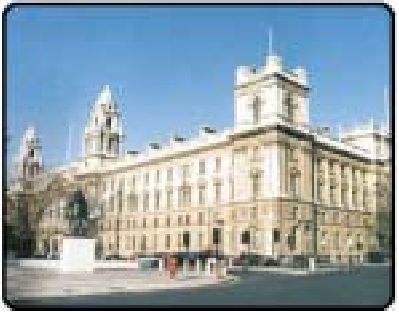
Government Offices, Great George Street - The PFI project for GOGGS will reinvigorate this important historic building, creating naturally ventilated, modern and flexible offices, enhancing the original features of the building. The scheme will embrace exisitng features, such as the light wells, and maximise the use of space. The whole life-cycle approach of this 35-year PFI deal allows for ongoing upgrades to maintain the accommodation in a desirable state and protect this historic building at the heart of Whitehall.
Civic Presence: Some buildings have long been used to enhance civic pride and as such have made landmark contributions to the built environment. Buildings which are constructed as part of a PFI project may become part of that process and, indeed, this may be encouraged where the circumstances warrant it, for example to mark the dignity and consequences of justice. Again, how this aspiration is to be costed, evaluated and described to bidders needs to be carefully thought out in advance of the competition.
Example: The design process for the Norfolk and Norwich Hospital project (see photo below) involved the full range of end users to achieve an effective healthcare outcome while, at the same time, the design team met the need to create a landmark building with a strong civic presence, a sense of hierarchy and suitable landscaped features. |
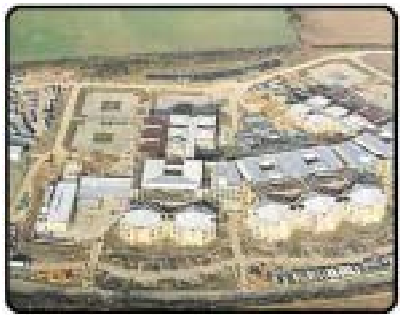
Aerial view of the Norfolk and Norwich Hospital PFI project nearing completion (February 2000).
2.13 The special design requirements covered in paragraph 2.12 may not lead to increases in cost. However if they do, it may not always be possible to afford such requirements because of other priorities for public expenditure. Decisions may, therefore, need to be taken about how to balance cost and quality in establishing an affordable budget, always with a long term view. Once these options have been costed and there is a clear idea about what is likely to be affordable, the public sector procurer must produce a firm brief which makes clear which elements of the bidding criteria are mandatory (eg elements of the output specification, levels of affordability) and which elements are targets. This is essential at the outset in order to avoid bidders incurring unnecessary costs without properly defined boundaries within which to work. The procurer must be able to account for the cost assumptions in its budget for any special elements in the specification such as those described in paragraph 2.12.
2.14 Given the constant pressures on public expenditure, the procurer should at the outset, or as an alternative or supplementary initiative where there are affordability problems, explore with potential bidders the scope for the commercial exploitation of the site by the contractor to generate third party income. Third party income may not be the only solution that might be identified, however. Options should normally be considered at the point at which requirements are defined (eg during market soundings). They could be undertaken later, although probably with less efficiency (eg by issuing the ITN initially in draft to shortlisted bidders) but even in the absence of project-specific affordability problems, wherever feasible, third party use should be encouraged through the ITN and bidders should seek to maximise it in order to reduce their net present costs.