Examples of good project planning
Preparations for the London 2012 Olympic and Paralympic Games: Progress report December 20111 - The Olympic Delivery Authority developed a robust procurement policy and process, including change control, and actively sought independent and expert challenge of its procurement activities. The Authority has also established financial incentives for the contractors to deliver ahead of time and under budget. As at November 2011 the Delivery Authority was on track to deliver its work on the Olympic Park on time, within budget and to the standard required.
Support to business during a recession2 - the Department for Business, Innovation and Skills took a conservative approach to risk, for example in pricing products, capping liability and limiting eligibility. With the exception of one riskier scheme, this allowed it to provide fast support to business whilst protecting the taxpayer from the associated uncertainty.
Department for Work and Pensions implementation of Employment and Support Allowance3 - The complex programme was on track for completion on time and under budget, helped by phased implementation, strong monitoring and risk management processes, collaborative contractor relations, experienced staff, and buy-in from staff and senior management.
The Procurement of the National Road Telecommunications Service4 - the Highways Agency negotiated a private finance deal that transferred some key risks to the private sector: when we reported some risks had already materialised and been borne by the contractor, not the taxpayer.
The BBC's Efficiency Programme5 - clear monitoring processes and accountabilities created strong incentives to deliver savings, and the BBC is on track to exceed its target of delivering £487 million sustainable, cash releasing net savings by 2012-13.
The Academies Programme6 - investing time to understand stakeholder needs at the design stage helped deliver one of the programme's key aims; good quality school buildings.
NOTES
1 Preparations for the London 2012 Olympic and Paralympic Games: Progress report December 2011, HC 1596, Session 2010-12
2 Support to business during a recession (HC490 2009-10)
3 Department for Work and Pensions Information technology Programmes (Memorandum to House of Commons Work and Pensions Committee, November 2008)
4 The Procurement of the National Road Telecommunications Service (HC340 2007-08)
5 The BBC's Efficiency Programme (Report to the BBC Trust, September 2011)
6 The Academies Programme (HC254 2006-07 and HC288 2010-11)
Major public sector projects are inherently risky. They often run over long timescales and are of a significant scale, ambition and complexity. Typically they involve multiple stakeholder groups with conflicting interests. Political imperatives can lead to challenging timescales and the failure to manage political and public expectations compounds the risks. The establishment of the Major Projects Authority in the Cabinet Office is a positive step, as are plans for a Major Projects Academy.
The delivery of public sector projects can be adversely affected by optimism bias. We have identified two main explanations. Technical causes comprise imperfect forecasting techniques, mistakes, inadequate data, and the obvious problems in predicting the future.4 A lack of objectivity and rigour in rational thinking can result in the over-estimation of benefits and under-estimation of costs.5 Often such biases are strategically motivated in order to increase the likelihood that a project gains funding.6
Our work shows that very few projects do enough feasibility work to develop a robust understanding of what is needed, if this is deliverable and how much it will cost. Departments should make the most of their power to set the framework for successful delivery. Striking strong and appropriate deals with contractors can put in place the necessary arrangements to enable them to run the project effectively.
Drawing on our extensive back catalogue of reports and understanding of current thinking in the project delivery professions, we have distilled a few of the key lessons that must be addressed when initiating projects. Applying these elements effectively will boost the chances of successfully delivering the project.
Five key elements for initiating successful projects
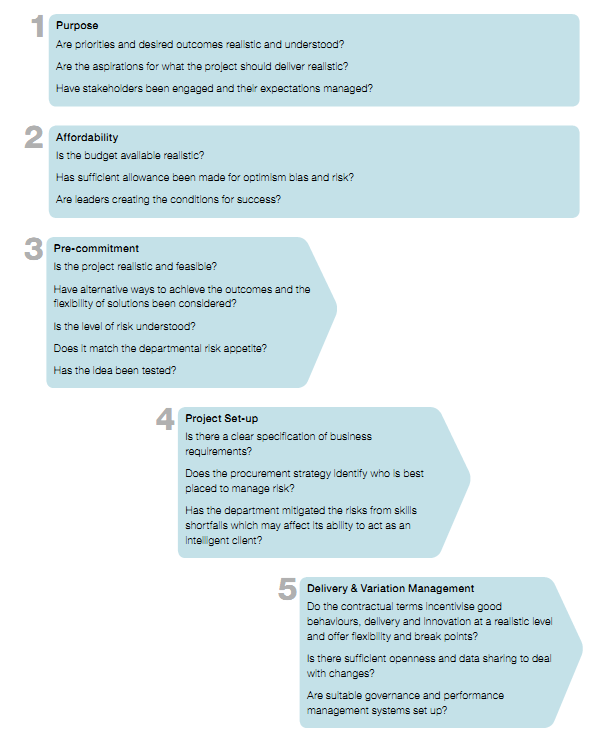
The elements are inter-related. A driver in the success of projects is the way public bodies balance the inevitable tensions between the elements and plan to deal with the turbulence that affects most projects. The elements are set out below.
__________________________________________________________________________________
4 PFI in Housing (HC 71, 2010-11).
5 Management of the Typhoon Project (HC 755, 2010-11).
6 Delivering multi-role tanker aircraft capability (HC 433, 2009-10).