1 The structure and role of the Efficiency and Reform Group.
1. The Government announced the formation of the Efficiency and Reform Group (the Group) within the Cabinet Office in May 2010. It is headed by a single official, Ian Watmore, acting as Chief Operating Officer for government. During 2010-11, the Group took the lead role in implementing new central controls on certain areas of departmental expenditure and in negotiating cost-cutting measures with major cross-government suppliers. In the short term the Group's strategy has concentrated on a limited number of areas, such as the procurement of common items. However, as its name implies, the Group's longer term priorities are to improve efficiency across the whole of central government and to introduce wider reform of public services.2
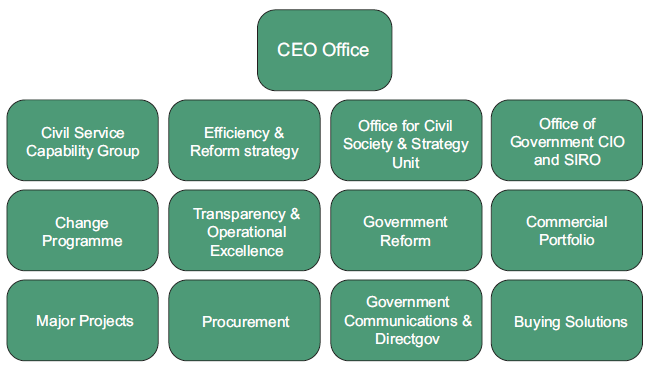
2. The Group was formed from a number of predecessor organisations, such as the Government Communication Group and the Office of Government Commerce (Figure 1). The Group expects to be more effective than its predecessor bodies for three main reasons: the impetus provided by the need to reduce the current deficit by £81 billion by 2014-15; strong ministerial support from the Minister for the Cabinet Office and the Chief Secretary to the Treasury; and the Group's responsibility for a range of corporate functions, giving it the ability to tackle common issues across Departments, such as procurement and project management which had previously been managed in a disaggregated way. The Group told us that bringing these functions together would enable the Government to develop a shared and uniform focus on key issues which impact on efficiency and effectiveness.
3. To date, the Group has depended for its effectiveness on its close personal working relations with the Treasury, which retains financial responsibility for departments' overall spending, and on the active role taken by Cabinet Office and Treasury Ministers in its day-to-day operations. The Group acknowledged that the effectiveness of this operating approach needed to be kept under close review and that, in the longer term, sustainable efficiencies would require permanent changes to institutional structures.3 The creation of the Group means there is an overlap between its responsibilites and those of the Treasury for pursuing value for money improvements across government - given that the Treasury retains its role to promote value for money in departments as part of its overall control over public spending.4
Figure 1
Structure of the Efficiency and Reform Group
NOTES
CEO - Chief Executive Officer
CIO - Chief Information Officer
SIRO - Senior Information Risk Officer
Figure source: Efficiency and Reform Group
4. Government property management is another example where responsibilities are confused at the centre. On 18 July 2011, the Government announced that responsibility for the overall management of the central government office estate would move to the Group from the Department for Business, Innovation and Skills (BIS).5 The property management function was previously split between the Group and BIS. The Group believed that the old arrangements were appropriate when the main objective of government property management was to obtain the maximum value from asset sales (which corresponds with BIS's areas of responsibility). However, the Group told us that the thinking on properly management had changed, and that it was now seen as integral to the civil service reform agenda; for example, it believed that co-locating departments could facilitate flexible cross-departmental working and secure financial savings.6
5. Under the Government's 'tight-loose' approach, the centre of government can coordinate or standardise action across departments where this would improve efficiency, while allowing departments the lead in other areas. The 'tight-loose' approach is intended to give the centre greater influence without diminishing departments' accountability for their spending and overall operations. However, the enhanced role for the centre has introduced some new tensions between the roles of the Group and individual departments in terms of determining who is accountable for achieving improved value for money. For example, in one of our previous hearings the Department for Work and Pensions told us that it had delayed progress with implementing online benefit applications because of the centrally imposed IT moratorium. The Group is able to intervene in the management of major public sector projects if they start running into significant problems, which means that departments' responsibility for their own projects is less straightforward than in the past.7
____________________________________________________________________________________________________________________
2 Q 1; C&AG's Report, paras 1 -3
5 HC Deb, 18 July 2011, col 87WS
7 Qq 78-82; oral evidence taken before the Committee of Public Accounts on 27 June 2011, Department for Work and Pensions Cost Reduction, HC 1351-i, Qq 13, 18