A. High bidding costs
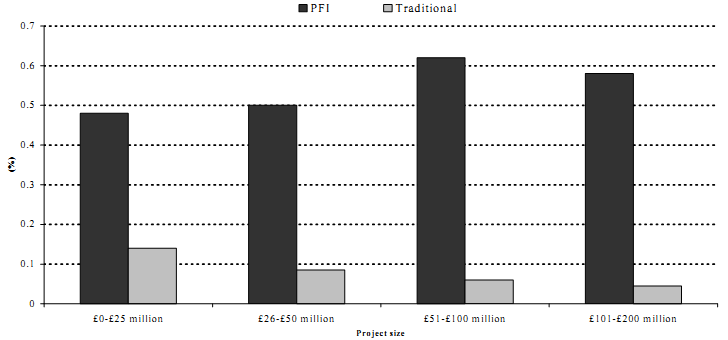
Private partners have often criticised the high cost of organising bids for PFI projects. It is argued that private sector contractors who tend for PFI project bids have to cover higher 'front-loaded' costs when drawing up detailed specifications and contract terms than when preparing bids for public services projects under conventionally tendered contracts. There is little hard evidence for the cost of the tendering process as it is usually considered confidential. The evidence that does exist appears to support the argument. A 1996 report from the Adam Smith Institute66 found average tender costs expressed as a percentage of expected total costs, across projects of all sizes, to be higher for PFI public services projects than for traditionally procured projects, as can be seen in the figure below:67
Tender costs as a percentage of project costs
The report suggests that on the basis of these figures:
• PFI tendering costs are far greater than the average tender costs of other procurement methods; and this remains true no matter what the project size.
• These tendering costs are likely to be underestimated, since many of the contractors approached revealed only the cost of achieving preferred tenderer status. The full costs [including the contract negotiation stage] are greater -perhaps not 0.5 percent, but one percent more.
• Unlike other procurement methods, where tender costs diminish as a percentage of the total, there are no economies of scale with PFI tendering. There is instead a tendency for costs to increase as a percentage of the total.68
The report finds the total cost of tendering for a PFI project to all potential contractors to be just under 3% of expected total costs while for traditional procurement the total costs accounted for just under 1%.
One reason for the higher cost of tendering for PFI projects is that the time taken between offering public services projects to the private sector and the final signing of the deal can be protracted, especially for particularly intricate and technical projects. The average time taken to complete PFI deals has been estimated at 26 and 42 months for local government and NHS projects respectively.69 There is some evidence to suggest that the relatively more expensive time spent negotiating PFI contracts with preferred bidders is longer than the time taken to initially select the bidder. If this time is not specifically included in either private or public sector cost estimates it increases total expected costs. These costs can be disproportionately high when the PFI project is small scale, such as a school's sports hall or GP's surgery.
To address these concerns, the Government has for some years been involved in consultations on establishing greater standardisation of the tendering process. On 14 July 1999 the Treasury Taskforce published new contract guidelines designed as "a platform for generating increased Private Finance Initiative (PFI) deal flow and reducing the costs of tendering".70 The aim of the guidelines is to allow future PFI contracts across different public services to follow a consistent approach by incorporating standard conditions into all contracts. The Audit Commission has also recently produced guidance for local government managers aimed at reducing the time taken to close PFI deals:
If purchasers are to reduce the length of time taken to close PFI deals, they should:
• demonstrate a clear purpose and a strong vision of the desired outcomes from the scheme;
• translate that vision into a simple output specification and resist the temptation to make regular changes to that specification;
• get early commitment to the scheme from key stakeholders;
• set up a project management structure that allows for an appropriate level of delegation to key officers and is integrated with existing decision-making processes;
• agree a clear project plan, establish project milestones and monitor progress against the plan on a regular basis;
• agree the key contractual terms, including payment mechanisms and risk transfers, prior to issuing the invitation to negotiate, in order to force bidders to indicate their position early on in the negotiation process; and
• be clear about how they are going to evaluate bids. 71
Revised guidance on the standardisation of PFI contracts from the OGC and Partnerships UK, expected early in 2002, should also help reduce the time taken to close PFI deals, reducing bidding costs for the private sector further.
____________________________________________________________________
66 Dr Eamonn Butler & Allan Stewart MP, Seize the Initiative, Adam Smith Institute, 1996
67 Source: Original source: BEC and Sir Michael Latham, Constructing the team, reproduced in Dr Eamonn Butler & Allan Stewart MP, Seize the Initiative, Adam Smith Institute, 1996
68 ibid.
69 Audit Commission, Building for the Future. The Management of Procurement Under the Private Finance Initiative, 2001
70 HM Treasury, PFI standard contract guidance launched, news release 118/99, 14 July 1999
71 Audit Commission, Building for the Future. The Management of Procurement Under the Private Finance Initiative, 2001