Government actions
3.37 The Government sees a long term strategic approach to planning how to deliver and use the UK's transport infrastructure as vital for success and is working to make sure that it carries out these responsibilities in as effective and efficient a way as possible. The independent McNulty Review, published earlier this year, examined the opportunities and barriers to improving the value for money of Great Britain rail for taxpayers, passengers and freight customers. The Cook Review examined whether the Government has the right approach to operating, maintaining and enhancing the strategic road network managed by the Highways Agency.
3.38 A number of Government initiatives are already progressing. The rail command paper will be published early in 2012, explaining detailed proposals to deliver a better value railway for the benefit of passengers, taxpayers and the wider economy. Next July will also see the publication of the High Level Output Specification which lays out what the Government wants the railways to deliver and ensures that the industry has clear and timely information so that it can plan to meet these aims. In March 2012, the Government will consult on the Sustainable Framework for
3.37 UK Aviation, which will set out the Government's long term plans for the sector. National Policy Statements (NPS) set out the Government's conclusions on the need to new infrastructure of national significance and provide the framework for deciding on such development proposals. The Ports NPS, laid before Parliament in October 2011, sets out the direction for UK's ports, and the National Networks NPS will do the same for strategic road, rail and strategic rail freight interchange infrastructure.
3.39 Alongside this wider programme of work, to keep Britain moving by improving the capacity, performance and resilience of roads, railways and international gateways the Government is delivering a programme of investment targeting some of the worst pinch points in the road and rail networks.
3.40 The Highways Agency is already in the process of delivering a number of schemes in this Spending Review period, to address congestion and improve performance on the Strategic Road Network. In addition, the Government provides funding to Local Authorities, who are best placed to identify the most stressed parts of the network in their local area, via the Local Authority Majors Schemes.
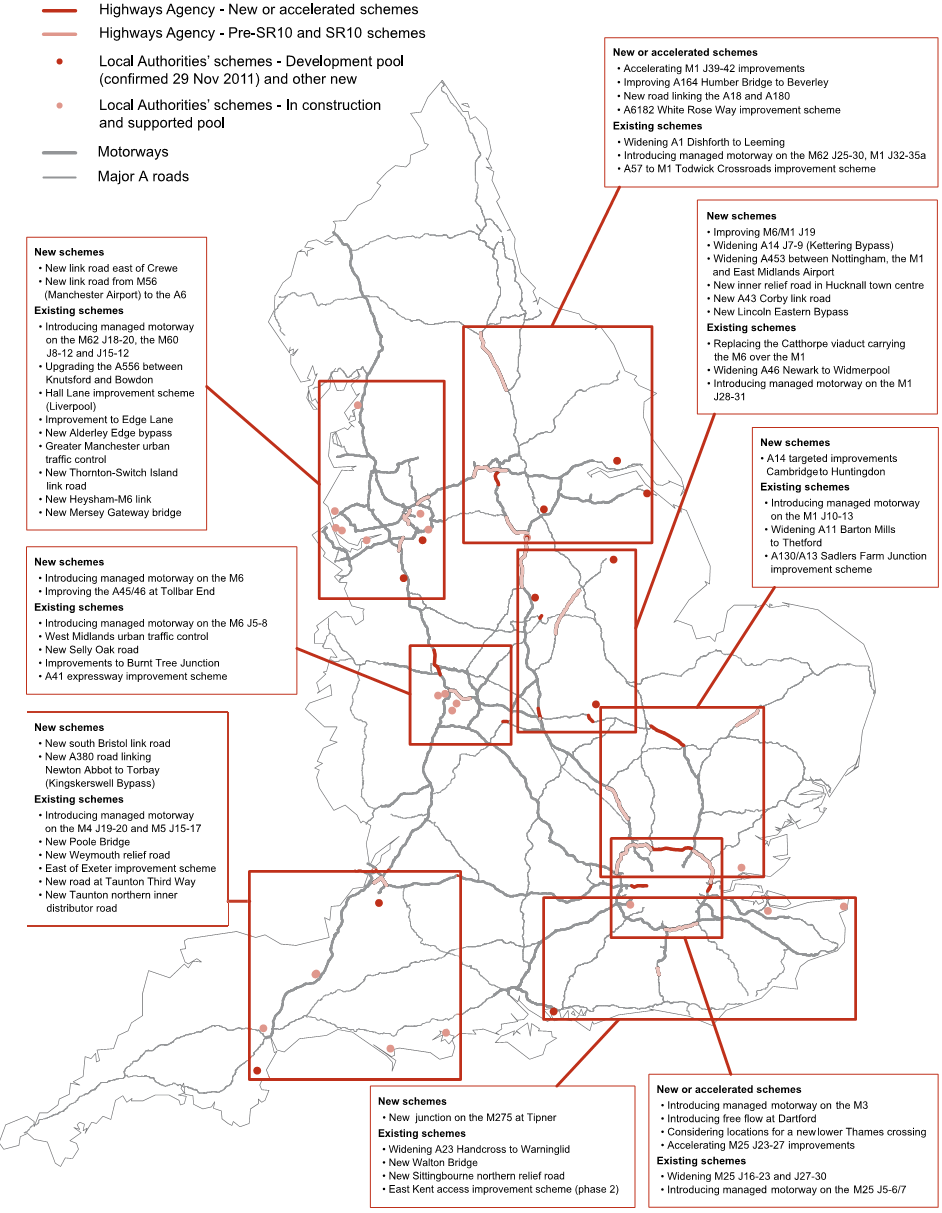
3.41 Combined with the new schemes identified in Chapter 2, this represents an ambitious programme to address the capacity, performance and resilience of the road network. These schemes are set out in the map overleaf.
Figure 3.B: Addressing congestion and improving performance on the road network
© Crown copyright. All rights reserved Department for Transport |
3.42 Network Rail is already in the process of delivering a number of schemes to improve our railways. Combined with the new schemes identified in Chapter 2, this amounts to a significant investment over this decade. A list of notable projects commenced in Control Period 4 (which runs from 2009 to 2014), and of the newly announced schemes, is outlined below.
Table 3.C: Network Rail schemes
Existing infrastructure projects |
|
Thameslink* | Crossraila* |
Reading station and environs* | Kings Cross station enlargement |
Birmingham New Street station enlargement* | North West Electrification* |
Manchester Ordsall Chord* | Great Western Main Line Electrification* |
Felixstowe – Nuneaton freight upgrade | Redditch and Bromsgrove route extensions* |
Cambridge station enlargement | North Cotswold redoubling |
Cardiff suburban network enhancement* Leeds station enlargement | Hitchin flyover* |
Southampton to West Coast Main Line W10 gauge clearance | W10 gauge clearance for Southampton to Basingstoke diversionary route via Andover |
Existing rolling stock projects |
|
Longer and more Pendolino trains for the West Coast Main Line | Intercity Express for Great Western and East Coast main lines* |
Additional peak capacity into London, Birmingham, Bristol, Leeds, Leicester, Liverpool, Manchester, Nottingham and Sheffield with a mix of new and re-used trains | New trains for Crossrail and Thameslink with existing trains anticipated to move to augment busy routes elsewhere* |
New infrastructure projects |
|
North Trans Pennine electrification | Network Rail Discretionary Fund |
New rail link between Oxford, Bicester, Aylesbury, Milton Keynes and Bedford | Bridge renewals |
Funding for winter resilience measures |
|
* Project commenced in control period 4 but is expected to continue/complete in control period 5. | |
3.43 Alongside this targeted programme of action, the Government will:
• implement a new specification for managed motorways which will reduce the costs of implementation by up to a quarter. This specification will be applied up to eight schemes in the Department for Transport / Highways Agency investment programme which are due to get underway between now and 2015;
• encourage proposals which involve an element of innovative financing – this might include proposals for tolling new infrastructure, or for releasing development gain;
• deliver the recommendations following a review of motorway closure incidents to ensure that the frequency of long duration incidents can be reduced. This includes reviewing the Road Death Investigation Manual to ensure there is a better balance between ensuring a thorough investigation of accidents and the need to keep traffic moving; developing a performance monitoring regime to compare performance across the county and publish performance data; completion of further analysis work to identify short, medium and longer term solutions to address the factors which contribute to longer duration incidents; and providing a £3 million fund to assist police forces in purchasing laser scanning technology to help speed up the investigation process at serious incidents;
• improve the use of existing capacity by making drivers better informed and more aware of their travel choices, including switching to less busy time periods, less busy routes and other modes of transport. This will be done by improving information about the consequences of disruptions and using better predictive models on the performance of alternative routes and modes. The release of good quality data and information about the performance of the network will encourage innovative, user-friendly travel applications to be developed by the private sector;
• continue to implement the £14.5 billion Crossrail project, connecting Maidenhead and Heathrow to the west of London, with Shenfield and Abbey Wood in the east, with services operational from 2018. This will deliver faster journey times, a 10 per cent uplift in London's rail-based capacity and bring an additional 1.5 million people within 45 minutes of London's business centres;
• work with the Office of Rail Regulation to ensure that the industry delivers the efficiencies already specified for the Control Period 4 regulatory period (2009 to 2014) and set clear requirements for the next regulatory period, Control Period 5 (2014 to 2019), in next summer's High Level Output Specification;
• publish a Command Paper in early 2012 setting out the means to deliver the efficiencies identified in Sir Roy McNulty's rail value for money report;
• take forward reform of franchising and work with the Office of Rail Regulation to implement measures to encourage closer working between train operators and Network Rail to increase the level of private investment in the railways and reduce the rail industry's infrastructure unit costs;
• continue to invest in rail infrastructure and rolling stock to improve inter-city connectivity, including improved services between cities in the North of England and better east-west connections in the rest of the country. The Government will continue to implement the Intercity Express Programme, which will deploy new trains to run on the Great Western and East Coast Main Lines, with electric services to Bristol, Oxford and Newbury commencing in 2016 and electric services between London and Cardiff in 2017. This multi-billion pound project will significantly enhance intercity rail travel, offering increased capacity on those lines and reducing journey times for passengers between London and Cardiff up to 20 minutes, and between London and Edinburgh by up to 15 minutes. Electrification of key routes in the North West and delivery of the Ordsall Chord project will improve connectivity between key Northern Cities; and
• actively explore the scope for promoting smart ticketing in a way that will enable and encourage operators to develop smarter fare options, both to manage peak demand and also to recognise that traditional options such as period season tickets, might not offer an attractive deal to passengers with a more flexible work pattern, for instance travelling regularly but fewer than four or five days a week. The Department for Transport intends to work closely with rail operators to pilot new smart products and evaluate their effect on peak demand levels.
3.44 Aviation makes a significant contribution to the UK economy and the Government is committed to continuing to work with industry to make the most of existing airport infrastructure across the UK. There is already significant private sector investment in airports. For example, Heathrow is investing £5 billion and Gatwick £1 billion in their capital investment programmes over the next few years. Stansted has recently invested £50 million in improving its terminal, Birmingham Airport is spending £65 million on a runway extension, and Bristol Airport is investing £150 million in expanding its terminal. Manchester Airport, which has recently become an Airport City Enterprise Zone, has recently invested £35 million in the development of Terminal 1, and Southend Airport is investing £57 million on a programme of expansion and improvement.
3.45 Improved terminal facilities and other infrastructure enhancements, combined with a shift to bigger aircraft, will enable an increase in throughput at existing airports. For example, at Gatwick passenger numbers could grow, without additional runway capacity, by substituting some short haul services with long haul services capable of supporting larger aircraft, thus resulting in a redistribution of the destinations served in favour of fast growing emerging markets. The first ever direct Vietnam-UK route will start at Gatwick in December 2011 with Vietnam Airlines' four services per week from Ho Chi Minh City and Hanoi. Air China has also recently announced that it will be starting a new service between Gatwick and Beijing from May 2012.
3.46 Alongside this private sector-led investment, to improve capacity, performance and resilience of international gateways the Government will:
• test the use of operational freedoms to improve the resilience of Heathrow, the UK's biggest and busiest airport. Operational freedoms allow certain tactical measures to be applied to anticipate, prevent and mitigate disruption and to facilitate recovery at airports. These measures include the use of both runways for arrivals or departures in limited and prescribed circumstances. These could deliver real benefits in terms of resilience and in reducing late departures (particularly unscheduled night flights), stacking and carbon emissions. The first phase of the trial of "operational freedoms" is already underway and the benefits and costs, including noise impacts on surrounding communities, are being carefully assessed in order to provide a clear evidence base on which to decide whether these measures can proceed beyond the trial stage to become a long term aspect of Heathrow operations;
• introduce a new, proportionate and responsive economic regulatory regime for airports by the end of 2013 to put passengers' interests at the heart of the regulatory framework and to encourage investment in airport facilities that is in the best interests of consumers;
• reform the way aviation security is regulated, with a stronger focus on outcomes rather than processes, enabling the same high standards or security (or better) to be delivered in a more efficient and passenger-friendly way; and
• engage with the Welsh Government on improvements to the M4 in south east Wales.
3.47 To improve integration between different modes of transport, the Government will:
• improve road and rail links to the UK's international gateways to help maximise the efficiency and competitiveness of the whole transport network. The public and private sectors are already working together to deliver improvements to surface access schemes to major airports. For example:
• Gatwick rail station is receiving £53 million jointly funded by Network Rail and the airport owner to upgrade the station, tracks and signalling including new platforms, escalators, a refurbished concourse and improved circulation areas. The work is planned to be completed by the end of 2013;
• Network Rail is working with BAA to develop a proposal for a new rail line from the Great Western Main Line near Slough to Heathrow which could provide significantly improved connections from the Thames Valley, the West of England and Wales to the airport;
• continue to invest in the Strategic Rail Freight Network, as outlined in the Logistics strand of the Growth Review. This includes unblocking private sector investment in Strategic Rail Freight Interchanges, to develop an efficient and sustainable logistics system which will continue to underpin economic growth; and
• continue to support the development and roll-out of integrated and smart ticketing schemes to enable passengers to make more seamless journeys.
3.48 The Government's forthcoming Carbon Plan will set out plans to support the move to a low carbon economy including a wide range of actions being taken to reduce the carbon intensity of transport. The key actions on transport infrastructure include:
• supporting the £30 million Plugged-in Places programme to encourage the establishment of plug-in vehicle recharging infrastructure across the UK;
• reducing carbon emissions while improving reliability and journey times through the electrification of the Great Western Mainline as far as Bristol and Cardiff, and of lines in the North West; and
• providing a policy framework which balances aviation's contribution to economic growth with its environmental impacts, both globally in terms of climate change and locally in terms of noise and air quality.
3.49 The Government's £560 million Local Sustainable Transport Fund will also help to reduce emissions from vehicles, improve air quality and rural transport connections, by helping local transport authorities do more to encourage walking and cycling, improve public transport and make better connections between different forms of sustainable transport.
3.50 In the short to medium term, there is a need for continued incremental development of road and rail networks to maintain and improve their performance and manage their environmental impacts. However, as demand pressures rise, there will be corridors on which this incremental approach will no longer be sufficient. In the longer term, therefore, there is a need to support schemes that deliver more significant improvements in capacity and connectivity.
3.51 The Government has announced further support for the transport system in the Autumn Statement. These measures are set out in Chapter 2.
3.52 To improve connectivity and capacity between main urban areas and between them and international gateways, the Government will:
• provide a framework to support the development of future schemes in the forthcoming National Networks Policy Statement;
• continue to focus future road and rail investment on the most appropriate schemes and projects, carefully considering their impact on growth, and recognising the potential for step changes in capacity; and
• continue to implement the Thameslink Programme, which will tackle overcrowding on some of the busiest commuter routes in the country investing around £6 billion in infrastructure and new trains. The programme will deliver increased passenger capacity with more train services and expand the Thameslink network to offer greater journey opportunities, including improved connectivity to Gatwick and Luton airports.
3.53 The Secretary of State for Transport will announce the Government's decisions on the proposed strategy for a national high speed rail network and, if appropriate, the preferred route from London to the West Midlands by the end of 2011, in light of all the evidence. Should the Secretary of State decide to proceed with plans for high speed rail, the Government would:
• legislate for the London-Birmingham phase of High Speed 2 by introducing a hybrid bill to Parliament by October 2013;
• prepare the second phase of High Speed 2 (the Birmingham-Manchester-Leeds route), consult and decide on a detailed route by December 2014; and
• work with stakeholders to determine the optimum use of the significant rail capacity released on the West Coast Main Line by the transfer of key long distance inter-city express services to High Speed 2.
3.54 To improve connectivity at an international level, the Government will:
• consult on extending the Government's regional fifth freedoms policy to Gatwick, Stansted and Luton to support London's and the UK's aviation connectivity, by attracting new services and additional stop-over flights to these airports. This would allow a foreign airline to carry traffic between those airports and another country as part of a service that begins or ends in the airline's home state. This would also help make better use of existing infrastructure at London's congested airports. The Government will consider extending the policy on a case by case basis pending consulting on the proposal early next year; and
• develop a long term aviation strategy which will set out how we intend to address the UK's airport capacity challenges, while ensuring aviation plays its part in delivering environmental goals and protecting the quality of life of local communities. The Government will publish a consultation on this strategy in March 2012. This will explore all the options for maintaining the UK's aviation hub status, with the exception of a third runway at Heathrow.
3.55 The Government is also committed to supporting London transport schemes that promote growth and contribute to the national economy. As such, the Government provides an annual grant to Transport for London to deliver transport services and investment in the Capital. This grant will total over £3 billion this financial year. The remaining two thirds of Transport for London's activities are funded mainly by prudential borrowing and fare revenue.
3.56 London's transport network is critical to maintaining London's status as a world class city, providing a variety of transport services for residents and visitors alike. London also makes a significant net contribution to the national economy, so the efficient operation of its transport network also helps drive growth across the UK as a whole, as the Mayor successfully argued during last year's Spending Review.
3.57 However, long term planning is key to maintaining and improving London's transport infrastructure, which is reflected in Transport for London's Business Plan and the Mayor's Transport Strategy. In order to support such long term planning, the Government committed to grant payments of £10.8 billion over four years, which will help fund infrastructure investments across the Capital, such as increasing capacity on the Jubilee, Northern and Victoria lines, improving the reliability of Underground journeys by investing in signalling, trains, bridges and tunnels etc, and expanding London's automated intelligent traffic control system. The Government will work with the Mayor of London and Transport for London to explore options for proposed additional river crossings, for example at Silvertown.
3.58 The Government has a shared commitment with the Mayor to deliver these economically important infrastructure projects in the Capital, which have the capacity to bring long term growth and prosperity to London and the wider UK economy.