Technology-specific challenges and actions
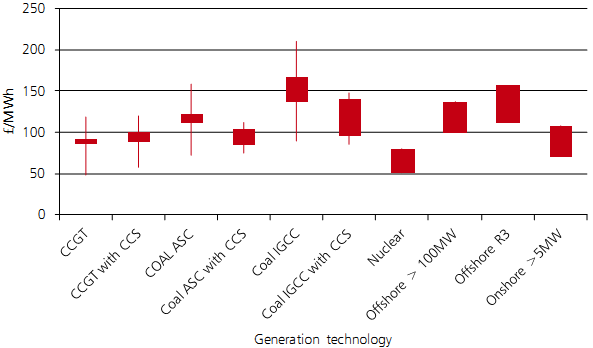
3.75 The Government's view is that, given the uncertainty about the evolving costs of different technologies (and therefore the optimal future generation mix) (see Charts 3.J below), market mechanisms will continue to offer the best way of allocating resources in the sector. Government interventions should therefore be focussed on providing clear carbon-price signals and incentives for adequate investment in capacity during a transition phase when electricity prices are likely to be volatile.
3.76 The Government's 2050 Pathways present a framework through which to consider some of the choices and trade-offs that will have to make over the next forty years. It illustrates the importance of assumptions on costs and deployment barriers in determining the most cost effective way of achieving a transition from a high-carbon to a low-carbon energy system.9
Chart 3.J: Levelised costs of electricity generation by technology
Source: Parsons Brinckerhoff (2011),b Arup/Ernst and Young (2011)c . Assumes 2017 project start date, established or "nth of a kind" technologies, and a central assumption of a 10% discount rate. The extent of high-low lines illustrate the range in costs implied by varying assumptions on fuel, carbon and capital costs. The height of the boxes indicates the uncertainty in capital costs only.
b Electricity Generation Cost Model - 2011 Update Revision 1, Department of Energy and Climate Change, 2011 c Review of the Generation Costs and Deployment Potential of Renewable Electricity Technologies in the UK, Arup, 2011 |
3.77 The goal for reform of electricity markets should therefore be a simplified set of technology-neutral interventions focusing on the three aims of energy policy: decarbonisation, security of supply and affordability for consumers. A clear carbon price will underpin this framework.
3.78 In the short to medium term however, it will be important to bring to maturity emerging low carbon technologies and to achieve cost-effective deployment of a new generation of new nuclear power stations and large scale offshore wind farms. The proposals for Electricity Market Reform therefore involve technology-specific support mechanisms (though Contract for Difference Feed-in Tariffs) to achieve this aim through the current decade. It is anticipated that, from the 2020s onward, there will be increasing convergence between technologies as they reach comparable stages of maturity.
3.79 It will also be crucial to decarbonise the supply of heat to buildings and industry, which accounts for nearly half of the UK's total energy demand. The Government will achieve this through a mix of different technologies and infrastructure, for example electric heat pumps, bioenergy and heat networks (district heating). The Government recognises the importance of heat for decarbonising the economy and deploying renewable energy, as well as the importance to consumers of heating our homes and businesses in a secure, affordable way. It will therefore publish its strategy for decarbonising heat in 2012.
3.80 There are, though, some specific actions that need to be taken to enable specific technologies.
__________________________________________________________________________________________
9 Available at www.decc.gov.uk.