Ensuring the affordability of UK infrastructure
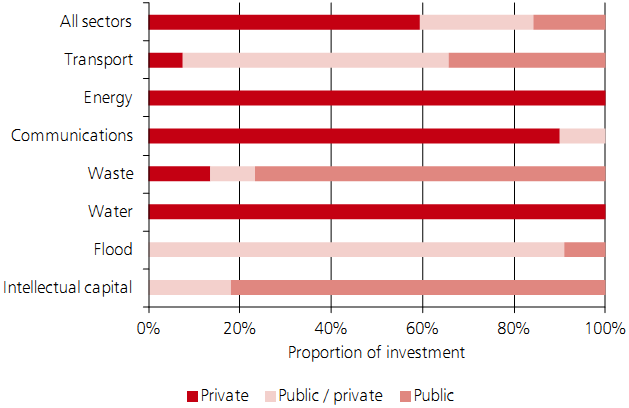
5.35 The UK has a diverse mix of funding models for infrastructure. Around two thirds of the investment pipeline identified by the Government will be funded by bill and fare-payers (see Chart 5.A). With investment levels expected to increase it is important that the Government takes action to ensure that users are able to afford these costs.
5.36 In many cases, the Government allows the market to drive efficiency and choice in infrastructure to the benefit of consumers. But some groups are particularly vulnerable to increases in utility prices, for instance households on low income or in homes which are difficult to insulate and energy-intensive businesses, so the Government is implementing a range of measures to ensure the UK's infrastructure plans are affordable.
Chart 5.A: Source of funding for infrastructure investments
Source: HM Treasury estimates, based on investment to 2015 and beyond. See Annex B for more information on infrastructure pipeline estimates. |
5.37 To keep downward pressure on the costs of infrastructure development:
• earlier this year the Government published its plan to implement the recommendations of the Infrastructure Cost Review, taking forward new approaches to improve programme management, make better use of the supply chain and encourage innovation to reduce the costs of investments. The Government is making further progress on infrastructure costs, including through improvements to the planning system (see Chapter 6);
• the Government is reforming the electricity market to provide clearer long term market signals for investors and reduce the cost of capital for new energy infrastructure (see Chapter 3);
• the Department of Energy and Climate Change-sponsored Offshore Wind Cost Reduction Taskforce will set a course to reduce the levelised cost of this technology to £100 per megawatt hour (from around £120-140 per megawatt hour in 2011);
• the Government will respond to the McNulty Rail Value for Money Study, setting out its proposals to work with the rail industry to drive efficiency and cut costs in order to put the railways on a sustainable footing for the future; and
• the Government is taking a longer term, more strategic look at how we can improve the governance and funding of the strategic road network to deliver better efficiency, effectiveness and customer service. The Government invited Alan Cook to lead this independent review and his report was published on 24th November. The Government will set out its response to this review by early 2012.
5.38 To make efficient use of utilities and reduce user costs:
• the Green Deal will provide impartial advice, accredited installation and improved access to finance for energy efficiency measures for both households and businesses;
• the Energy Company Obligation will subsidise the installation of measures for hard-to-treat homes such as solid wall insulation. There are nearly seven million solid wall homes that are not insulated. A three bed semi detached property could save around six megawatt hours per year;
• completing the roll-out of smart meters will help households reduce their energy consumption and smooth their electricity use to reduce costs overall;
• October's consumer energy summit launched the 'Check, Switch, Insulate to Save' campaign. This has brought together Government, Ofgem, consumer groups and energy suppliers to help people to manage their energy bills this winter through home insulation to cut energy consumption and shopping around for the lowest possible energy prices. Government requires energy suppliers to offer discounted or free home insulation under the Carbon Emissions Reduction Target scheme and suppliers have agreed to inform customers about their cheapest tariffs and the savings from direct debit; and
• households in the South West face by far the highest water bills in the country. The Government has decided to fund South West Water to enable it to cut bills by £50 per year for all household customers.
5.39 To target support to those customers who are most vulnerable to cost increases:
• the Government intends to implement measures to reduce the transitional impact of policy on the costs of electricity for the most electricity-intensive industries, beginning in 2013 and worth around £250 million over the Spending Review period. As part of this the Government will:
• compensate key electricity-intensive businesses to help offset the indirect cost of the carbon price floor and the EU Emissions Trading System, subject to state aid guidelines;
• increase the level of relief from the climate change levy on electricity for Climate Change Agreement participants from the current level of 65 per cent to 90 per cent; and
• explore options for reducing the impact of electricity costs on electricity-intensive industries as a result of Electricity Market Reform policies where this has a significant impact on their competitiveness;
• the Warm Home Discount scheme will run from 2011-12 to 2014-15 and support around two million low income and vulnerable households per year with their fuel bills. The current Warm Front scheme will run to 2012-13 and help over 90,000 low income and vulnerable households to keep warm with heating and insulation measures;
• Cold Weather payments and Winter Fuel payments will help eligible households pay their energy bills;
• as with the current Carbon Emissions Reduction Target measure, the forthcoming Energy Company Obligation will be targeted at vulnerable or low income households and those who face particular barriers in reducing their energy consumption; and
• the Department for Environment, Food and Rural Affairs' Water White Paper, to be published in December 2011, will set out in more detail what the Government will do to ensure households continue to receive a secure and safe water supply at prices they can afford.