1 INTRODUCTION
1.1 Much of the published guidance on governance is pitched at the corporate or organisational level and focuses on regulatory activities, or on change programmes (often based on information technology). The focus of this project governance guidance is the efficient instigation and delivery of public sector projects. It is intended to be a prompt for what should be addressed by those in the public sector responsible for the efficient and effective delivery of projects.
1.2 In this document the term:
• "project" covers the whole life cycle: from and including initial studies, feasibility assessments, the production of outline and full business cases, the procurement process and transition through to, service delivery and disposal or exit. Taking time to put in place good project governance is especially important on complex and risky projects;
• "Authority" or "Procuring Authority" describes the public sector body responsible for the project; and
• "Contractor" describes the private sector parties contracted by the Authority to deliver various parts of the project.
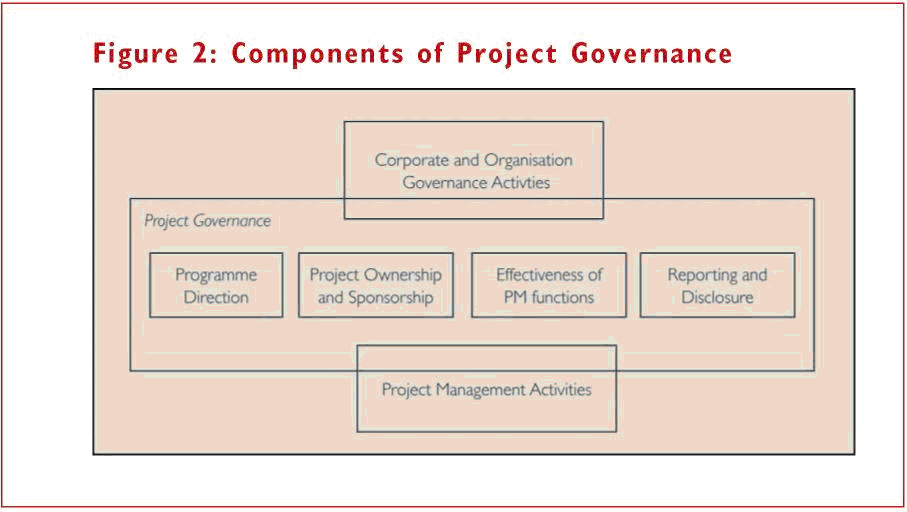
1.3 As the demarcation between organisational controls and project management activities is ill-defined, the guidance does not seek to distinguish accurately between overlapping areas. At any point in the life-cycle of a project, the project governance put in place should be seen as defining the specific arrangements that are required for the project within this overlapping area - see figure 2.
1.4 Time and effort is needed, sometimes at the highest levels in an organisation, for the project governance arrangements to function correctly and provide stakeholders with confidence in the arrangements. A project's governance structure needs to evolve during the life of a project, and therefore it should be reviewed regularly as it moves from one phase to another. The structure for each phase will need to consider the requirements for that phase and the resulting arrangements should be included and justified in project approval and business case submissions to allow stakeholders to review their adequacy. The project governance structure should also be available as a reference document for independent project reviews. The project plan should highlight key authorisation points and tie these in with the schedule of project governance meetings or other stakeholders' engagement points.
1.5 The aims of a project governance structure are to:
• Set out lines of responsibility and accountability within the Authority for the delivery of the project;
• Give the stakeholders in the Authority the ability to manage their interest in the project;
• Support the Authority's project team to deliver the required outcomes by providing resources, giving direction, and enabling trade-offs and timely decision taking;
• Provide a forum for issue resolution;
• Provide access to best practice and independent expert advice;
• Disseminate information by reporting to stakeholders so that they can effectively fulfil their roles; and
• Provide a framework for project disclosures.
1.6 The NAO and OGC list eight common causes of why projects run into difficulties. Five of these are concerned with project governance:
• Lack of clear link between the project and the organisation's key strategic priorities, including agreed measures of success.
• Lack of clear senior management and ministerial ownership and leadership.
• Lack of effective engagement with stakeholders.
• Lack of understanding of and contact with the supply industry at senior levels.
• Inadequate resources and skills to deliver the overall programme.
1.7 There are a number of different ways if delivering effective projectgovernance. Some of the structures and mechanisms that can be used can sometimes conflict with each other and so it is important to identify any potential problems at the outset and ensure that any necessary protections are in place.
1.8 This guidance looks at a number of aspects of project governance, draws attention to why they should be addressed and offers suggestions for implementation. The intention is not to set out a rigid template but to provide a framework for Authorities to think through the issues and how best to resolve them. Also included is a consideration of the roles of independent reviews (such as the OGC Gateway reviews), the links to the formal project approval processes (such as Project Review Group (PRG) for some Local Authority projects), and the impact of public sector issues.