Forecast costs have risen by nearly £0.5 billion
1.2 The current Major Projects have a total forecast cost value of £59.6 billion against an initial approved cost of £53.5 billion. The total cost increase is £6.1 billion, or 11.4 per cent. Of this, £466 million (0.9 per cent) is from 2010-11 and includes £113 million spent on capability enhancements.
1.3 The approval and forecast cost figures in this year's Report are not directly comparable with the figures in Major Projects Report 2010 because they have been re-stated to remove cost of capital, in line with HM Treasury's 'clear line of sight' policy implemented on 1 April 2010.9 This has had the effect of removing some £3.8 billion from approved costs and £6.2 billion from the forecast cost of these projects.10
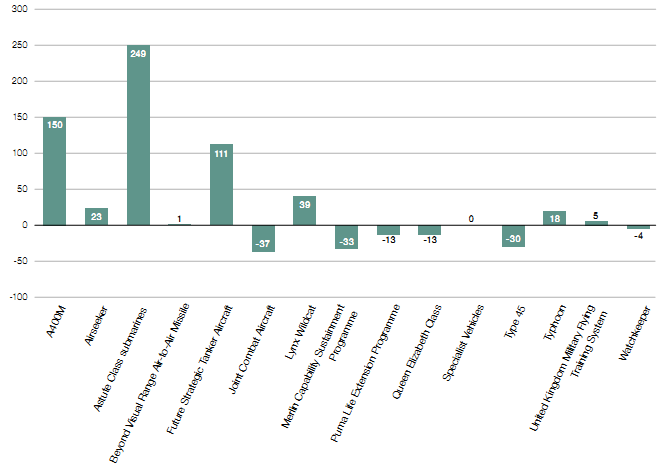
1.4 Figure 3 shows the in-year cost variation for each of the 15 post-main-gate projects.
1.5 Of the £466 million cost increase:
• £237 million was from central planning decisions made by the Department and capability enhancements to equipment above that originally planned.
∙ Short-term decisions to save money have added £124 million. The most significant of these was on the Astute Class submarine programme, which is examined further in Part Three of this Report.
∙ £113 million has been added through increases to capability requirements including: an increase in the numbers of Lynx Wildcat helicopters from 62 to 66 (+£37 million net increase);11 investment on the Future Strategic Tanker Aircraft to address platform protection issues and increase the utilisation of the aircraft (+£124 million); and a change in the Joint Combat Aircraft programme requirements (-£71 million).
• £176 million has been added by macro-economic factors, primarily exchange rate changes on the A400M aircraft (classified), Typhoon aircraft (+£91 million) and the Joint Combat Aircraft (-£35 million).
• £53 million from project-level difficulties such as design and contracting issues, most notably on the Joint Combat Aircraft (+£72 million) though savings were realised on the Typhoon aircraft (-£63 million).
Figure 3 In-year cost variation (£m) |
|
NOTES 1 The variation shown for Astute Class submarines includes changes against the main investment decision for boats one to four as well as variation against some initial purchases approved for boats five and six. 2 The variation shown for Typhoon includes both Typhoon and the Typhoon Future Capability Programme. 3 The variation shown for United Kingdom Military Flying Training System includes: Advanced Jet Trainer; Advanced Jet Trainer Operational Capability 2; Advanced Jet Trainer Ground Based Training Environment; and Rear Crew Stage 1. Source: National Audit Office analysis of Departmental data |
____________________________________________________________________________
9 Cost of capital was a notional opportunity cost from using money in capital expenditure projects instead of alternative investment opportunities. The clear line of sight policy aims to simplify financial reporting to Parliament ensuring that it reports in a more consistent fashion.
10 Appendix Three has a full reconciliation between last year's approved costs and revised approved costs after cost of capital was removed.
11 There are two types of Lynx Wildcat helicopters: the Battlefield Reconnaissance Helicopter of which 38, (a net increase of four in 2010-11), are now being procured with eight of these to be subsequently modified to Light Attack Helicopter standard; and the Surface Combatant Maritime Rotorcraft of which 28 are being procured.