Background and capability of the Nimrod aircraft project
3.10 The Nimrod Maritime Reconnaissance and Attack Mk4 aircraft (the Nimrod maritime patrol aircraft) was planned as an upgrade of the existing Nimrod maritime reconnaissance Mk2 aircraft. The Department placed a contract in 1996 to upgrade 21 existing Nimrod Mk2 aircraft to the enhanced standard, although the ultimate design was 95 per cent new build. The new aircraft was to provide enhanced anti-surface and anti-submarine warfare; maritime reconnaissance and strategic intelligence collection; search and rescue; and an attack capability. Figure 16 overleaf outlines the background for the Nimrod maritime patrol aircraft project.
3.11 The Nimrod maritime patrol aircraft project has had a long history of delays and cost increases reflecting a mixture of technical problems, resourcing shortfalls and the need to incorporate the cost increase within the constrained Defence budget. After main-gate approval in 1996, the Department renegotiated the contract with BAE Systems in 1999, 2002 and 2003. The last renegotiation was mostly responsible for total forecast cost growth of £789 million by the time the project was cancelled in October 2010. Programme difficulties stemmed from 'the design challenge being hugely underestimated by industry' compounded by a weak programme management culture which lacked transparency, neglected or overrode project control systems and disciplines, and produced forecasts that 'lacked depth and reality'.22
Figure 16
Background to the Nimrod Maritime Patrol Aircraft
Background to the Nimrod Maritime Patrol Aircraft programme | |
Date of main-gate decision | July 1996 |
Original approved cost | £2.8 billion |
Total increase in forecast cost since original approval | £789 million |
Total spend to 31 March 2011 | £3.4 billion (not including cancellation costs) |
Original approved in-service date | April 2003 |
Delay to in-service date since original approval | +114 months |
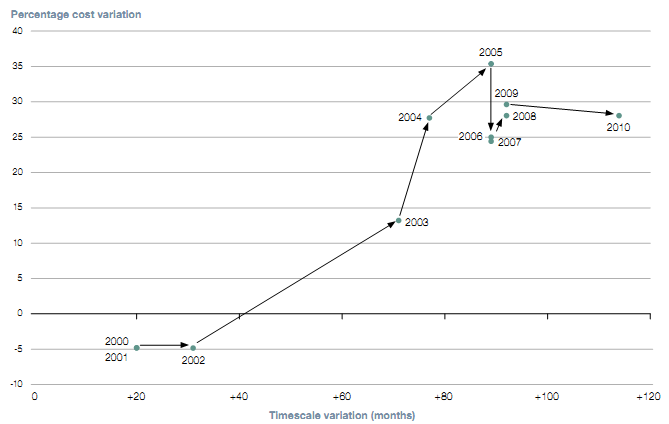
Programme history The majority of the problems occurred on Nimrod in the first seven years following its main investment decision. Technical and commercial difficulties were eventually resolved in 2003 after the Department renegotiated the contract with BAE Systems. It was this period that primarily caused the £789 million cost increase, with time delays to this date of 74 months. The number of aircraft to be purchased was reduced from 21 to 18 to stem the cost increases. In 2004 this was reduced further to 12 and a further delay of six months was reported. In 2005 the in-service date slipped a further 12 months due to short-term budget constraints within the Department, and three years later the number of aircraft to be purchased was reduced to nine. Finally, in 2009 the Department further delayed the in-service date, this time by 22 months, again to save money in the short term. In 2010, the Nimrod maritime patrol aircraft was cancelled bringing to an end a 14-year procurement history having spent over £3.4 billion. Source: Project summary sheets 2000-2011 | |
3.12 The forecast in-service date of the Nimrod maritime patrol aircraft was successively delayed from April 2003 to the final estimate of October 2012; creating a 114-month slippage. There were two main reasons for these delays: Departmental funding constraints, leading to resources being re-prioritised in the short term; and industry underestimating the design challenge and technical complexity in their initial forecast schedule. Figure 17 illustrates the repeated cost increases and delays to the in-service date of the Nimrod maritime patrol aircraft.
Figure 17 |
|
NOTES 1 Graph shows the respective positions and movements of the Nimrod maritime patrol aircraft in each year between 2000 and 2010. 2 Nimrod was not part of the population in Major Projects Report 2011 and so is not shown in the above graphic. 3 Figures are all inclusive of cost of capital and are as reported in Major Projects Reports 2000-2010. Source: National Audit Office analysis of Departmental data |
3.13 Ongoing technical difficulties created risks to achieving the aircraft's key performance measures. In 2005 two of the ten key performance measures were put 'with risk'. By 2009 the 'Operations in hostile environment' key performance measure had changed to 'Not to be met' and all but one of the remaining measures were reported 'with risk'. In that year a further set of metrics also reported all but one of the eight defence lines of development, which measure the other aspects of military capability such as training and logistics, as 'with risk'.
3.14 To address cost overruns on the project, the number of Nimrod maritime patrol aircraft was reduced from 21 to 18 aircraft in 2002, to 12 aircraft in 2004, and further reduced to nine in 2008. The Department reported that each reduction in aircraft numbers still allowed the defence requirement to be met, but only after adjusting down the requirement on each occasion, as the reductions were financially driven.
______________________________________________________________________________________________________________________
22 Major Projects Report 2003: HC 195, Parliamentary Session 2003-04.