Airseeker
Airseeker The Capability Project Airseeker (formerly known as Helix) seeks to sustain the UK's airborne electronic surveillance capability provided by the Nimrod R1 aircraft and associated ground elements, against an evolving and increasingly complex target set up to 2025. It will provide a rapidly deployable capability to support operations where it will be able to collect, analyse, fuse and disseminate a coherent and readily interpretable electronic surveillance picture in support of national, joint and coalition operations. This information will support targeting and combat identifications. |
| |||||
Overview of Cost, Time and Performance | ||||||
| Approved | Forecast/Actual | Variation | IY Variation | ||
Cost of Assessment Phase | £44m | £38m | -£6m | - | ||
Cost of Demonstration & Manufacture Phase | £659m | £681m | +£22m | +£23m | ||
Cost of Support Phase | £680m | £ 6 41m | -£39m | +£11m | ||
Duration of Assessment Phase |
| 79 months |
|
| ||
In-Service Date | October 2014 | October 2014 | 0 months | 0 months | ||
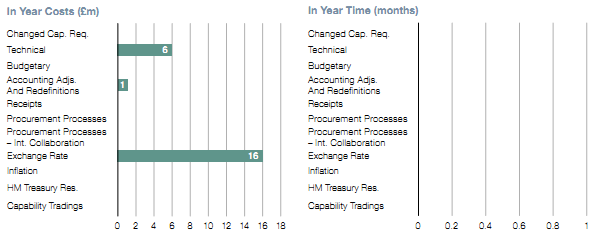
In-year Cost and Time Variation Detail | ||||||
| ||||||
A Letter of Offer and Acceptance was signed on behalf of the UK government on 19 March 2010 which included a request for the US government to prepare and submit a revision to that letter reflecting the Planning Round 2010 settlement. Their formal response was received on 28 October 2010. Investment Approvals Board approval to sign the revised offer letter was received on 24 March 2011. The revision to the offer letter has been augmented by additional information on how the US Government Program Office, known as Big Safari, intends making contractual commitments on behalf of the UK. The US Government has been implementing the initial stages of the Foreign Military Sales agreement in accordance with a plan that is consistent with the Planning Round 2010 settlement. A major milestone was achieved on 14 December 2010 when the first donor aircraft for conversion to become the first UK Rivet Joint aircraft was taken into work at the USA facility in Texas. | In September 2010, Royal Air Force Headquarters Air Command signed an agreement known as the Co-manning Memorandum of Understanding with the operational wing of the US Air Force that operates the Rivet Joint aircraft and ground systems. This agreement makes provision for UK crews to be trained by the US Air Force, funded under the Foreign Military Sales case that is managed by the Airseeker Project Team, and then allocated to operational duties by the US Air Force Rivet Joint Commander. The first of the RAF personnel started training in January 2011, with the first graduates ready for operational Rivet Joint deployments in June 2011. This conversion training and operational experience will provide the required quantity of trained manpower to meet the Initial Operating Capability whilst significantly de-risking the Training Defence Line of Development. | |||||

Risk Assessment against Defence Lines of Development
|
|
|
|
|
|
|
|

