Recommendation of preferred redevelopment option
The purpose of the feasibility study was to provide a comprehensive analysis of each of the options. Although it provided information about cost and risk ratings for each option, the evaluation was predominantly undertaken against socio-economic criteria, as follows:
● model of care-the extent to which the model of care can be achieved (including improved access to intensive care and other key clinical support services)
● functionality-the extent to which an option improves functionality and efficiency and improved patient amenity (including the host hospital for co-location options)
● identity-extent to which separate identity can be assured through the design (including separate entry and privacy)
● flexibility of infrastructure-ability to be adapted as technology and demand changes
● maintenance of services-capacity to maintain hospital operations and building engineering services during construction
● teaching, training and research (TTR)-the extent to which the option can accommodate TTR requirements
● patient accessibility-geographic accessibility, particularly in relation to services for women in the inner northern and inner western suburbs and rural/regional Victoria
● public transport accessibility
● ease of navigation around the site
● layout during construction-impact on patients, visitors and staff during construction
● construction time-including capacity for staging.
The option selected-option M5-was neither the lowest cost option, before asset sales, nor the lowest risk option; the risk, however, was not significantly different from the other options.
Overall, option M5 outscored the other options in the socio-economic evaluation for the following reasons:
● the option was considered to provide the best 'fit' for the future delivery of services under the RWH model of care
● better functionality, identity, flexibility, capacity to maintain services during construction, accommodation of teaching, training and research requirements, patient accessibility and construction time
● particular disadvantages of redevelopment on the existing site included the lack of connection to an adult teaching hospital, the relatively higher level of impact of construction activities on maintaining services during construction, and the significantly longer construction timeframe associated with the refurbishment of the existing, outmoded, main tower
● the option offered the highest potential for achieving ongoing recurrent cost efficiencies through the sharing of services and infrastructure with the Royal Melbourne Hospital.
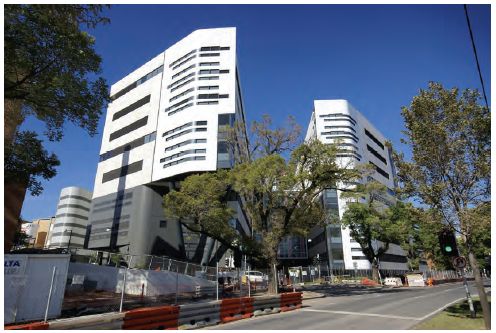
A view of the nearly completed facility from Flemington Road.