Delivering on time
4.7 A key focus of the research was to assess how far PFI delivered new assets on time. The sample suggested that PFI was delivering new assets on time across the public sector. 88 per cent of projects were built on time or early. This strong track record of PFI is borne out by a comparison of the HM Treasury findings with those of the National Audit Office (NAO). A recent NAO report1 found that of a sample of 37 projects, only 8 per cent of PFI schemes were delayed by more than two months.
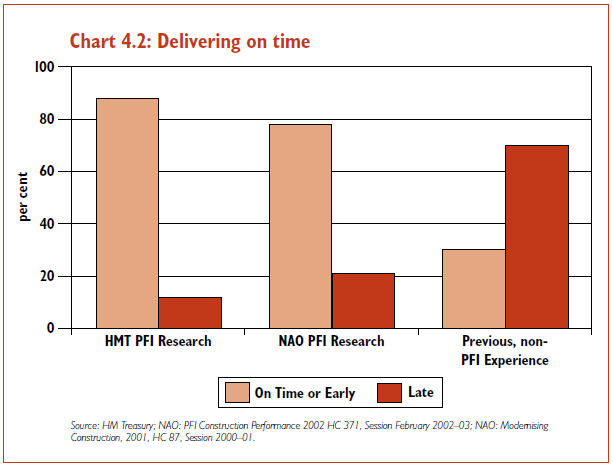
4.8 The track record of conventional Government construction projects has been considerably worse in this respect. Other research into previous non-PFI construction performance has shown that around 70 per cent of conventional construction projects came in late2.
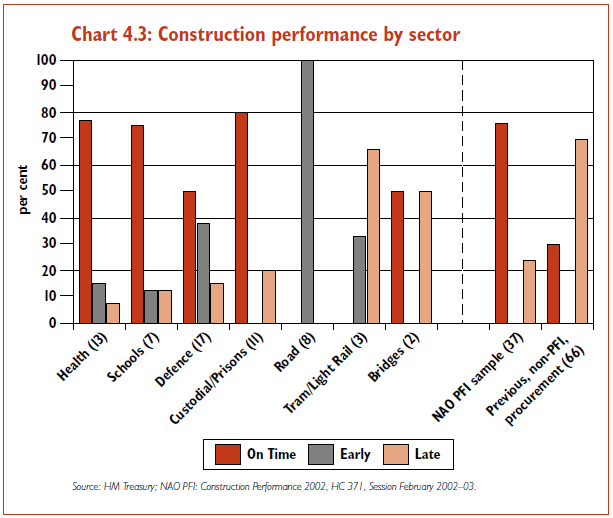
4.9 Chart 4.3 shows PFI construction performance by sector. For school, hospital and defence projects (of which a high proportion were accommodation projects), very few schemes experienced delays. No prison and road projects surveyed were delivered late. In some sectors, such as light railways, the planning difficulties in densely populated urban areas and inherent inflexibilities in the schemes mean that PFI has been less successful in meeting initial delivery timetables. However, unlike conventional procurement, the direct financial costs associated with these delays were not borne by the public sector and payment only began to flow to the private contractor once the asset was complete and the service was underway.
___________________________________________________________________________
1 PFI: Construction Performance, NAO, 2003.
2 Modernising Construction, NAO, 2001.