Overview
7.21 Where PFI has demonstrated that it can deliver value for money based on a rigorous and even-handed appraisal process, it should be used as one important tool to deliver the Government's significant increases in public investment. The Government's analysis suggests that PFI has been successful in delivering high quality facilities for public services, with the benefit of on time and on budget delivery in certain key sectors of public investment. These sectors - particularly health and education, but also defence and transport - display certain common factors which mean that the continued use of PFI has a sound value for money basis. Consequently, the Government plans to continue to use PFI to deliver part of its plans for rapidly increasing investment in these sectors.
7.22 Consequently, the Government expects a significant number of major new capital investment projects to continue to be procured using PFI in 2003 and 2004, as in Chart 7.1 below. Chart 7.1 shows the projected capital value of PFI projects by key Departments that are currently in the procurement process and expected to reach financial close by 2004, alongside the expected total capital value of signed and unsigned projects expected to close in 2003, and the actual capital value of deals signed in 2002. Even with these increases, the speed of conventional capital spending growth is projected to be such that PFI will remain broadly at the same small but important proportion of total investment as it is today.
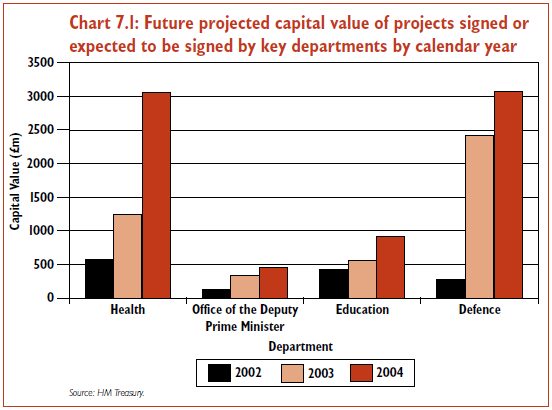
7.23 The Department of Health are expecting to see both the number and capital value of deals signed rise significantly over the next two to three years. The projected number of deals for health is 55, amounting to a total capital value of £6.5 billion by the end of the 2005 calendar year. The projected capital value for Ministry of Defence PFI projects is also expected to rise with an estimated 14 deals totalling £5.7 billion over the same period.
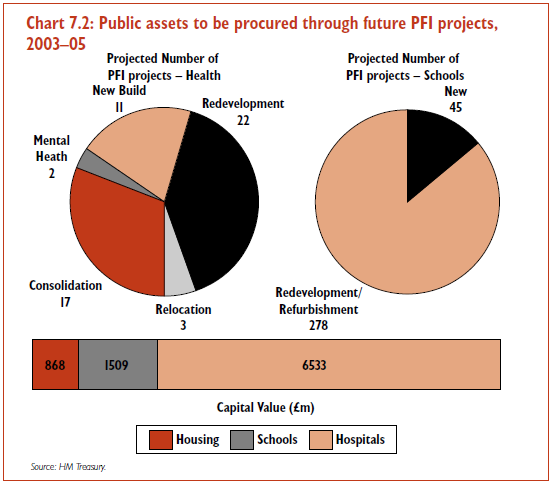
7.24 This investment is expected to deliver significant new public infrastructure over the next few years. As shown in Chart 7.2 above, the PFI investment programme in health projects is expected to deliver 11 new hospitals or other health facilities, and redevelop or consolidate to a central site 44 more. In education, £1.5 billion in planned investment will redevelop or refurbish 278 schools and deliver 45 new schools. In housing, 28 PFI projects will deliver capital investment estimated at over £800 million, even without the potential new applications of PFI in social housing discussed at paragraph 7.53 below.
7.25 Furthermore, in secondary schools, the Building Schools for the Future initiative has recently outlined an extensive investment programme that will involve the use of PFI and conventional procurement. It is expected that the initiative will lead to sustained investment in secondary schools worth £2.2 billion in 2005-06.