RATING AGENCIES AND UK PPP PROJECTS
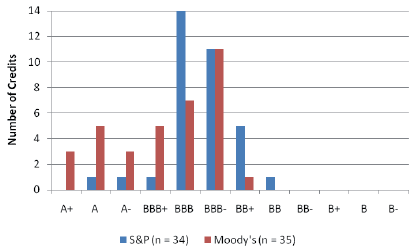
| Standard & Poor's rates 34 PFI projectsviii. Moody's rates 40ix, five of which are not made public. 27 PFI projects are rated by both agencies. On average, for those 27, Moody's FIGURE 1: RATING DISTRIBUTIONS FOR PFI CREDITS
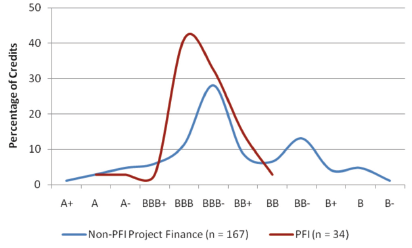
rates one notch higher. The rating distributions are shown in Figure 1. The average underlying PFI rating from Moody's lies between 'Baa2' (equivalent = 'BBB') and 'Baa1' ('BBB+'). The average from FIGURE 2: RATING LANDSCAPES FOR S&P'S PROJECT FINANCE UNIVERSE
Note: Projects with local country ratings and monoline guarantees are omitted from this figurex Standard & Poor's lies between 'BBB-' and 'BBB' (just one notch higher than the average for all of S&P's non-PFI project finance ratings - see Figure2). 66 percent of Moody's (public) PFI ratings and 75 percent of S&P's PFI ratings respectively lie clustered in the low investment-grade ('BBB') rating category. However it is in the 'A' rating category where the agencies' views diverge most. Whereas 31 percent of Moody's PFI credits sit in 'A' territory, only 6 percent of S&P's credits share the same space. A key reason for this derives from a fundamentally different approach taken to rating transitions - a fact that is not immediately discernible from snap-shots of rating distributions. Moody's credit research repeatedly highlights the fact that - particularly for standard, availability-based PFI projects - the agency expects ratings to be upwardly adjusted on successful completion of construction; typically to 'A'. Reflecting the perception of lower project risks post-construction, much of the bank market clearly thinks similarly. Witness margin step- downs in lending documentation and the trend for (lucrative) post-construction refinancing - before the 2002 introduction of compulsory gain-sharing with public sector promoters. S&P does not share this view. The majority of their PFI credits initially assigned 'BBB' category ratings remain there. Conceptual arguments can be (and are) advanced in support of either approach but two things are for certain. Empirical evidence would help strengthen such arguments - and both can't be right. |