A. BASE COSTS and PREMIUM
Figure #2
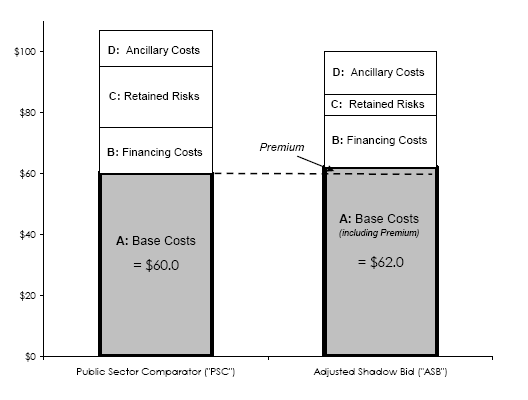
The estimate of base costs generally includes:
• construction costs;
• lifecycle costs1;
• hard and soft facility management costs1; and
• premium (under ASB only)
Unless there are compelling reasons to assume otherwise, the base costs under the PSC and the ASB should be assumed to be identical as a starting point, with the exception that the AFP base costs will include a premium (as shown by the dotted line in Figure #2). This premium is included by the private-sector party as compensation for the added risks transferred to them under the AFP contract.
Where clear base cost advantages to proceeding using AFP can be anticipated or are revealed in bids, they should be factored into the VFM Analysis. A couple of examples may serve to illustrate. Were a hospital to consider putting out to tender a fully designed addition project, it might rightfully determine that there were few opportunities for innovation in the actual construction of the project. Consequently, the base construction costs could be assumed to be identical under traditional and AFP delivery. Unless the bids contradicted this assumption, it would underlie the VFM analysis throughout the process. Conversely, were a hospital to consider putting out to tender a project for design, build and maintain, it might assume that there were opportunities for innovation and efficiency in the delivery and operation of the facility under AFP. However, prior to receipt of bids, it might conservatively determine not to factor these into the analysis. Once bids were received, if there were clear bases for using different base costs for the PSC and ASB, such as unanticipated design innovations, construction techniques or operating expenses, the base costs would be different under the PSC and ASB.
Prior to the receipt of bids, the best means of estimating base project costs is to have professional industry experts' estimate the:
Cost element | External Source of Data |
Construction Costs | Construction cost consultant |
Lifecycle Costs | Lifecycle cost consultant |
Facility Management Costs | Facilities management cost consultant |
The relevant cost consultants also estimate, based on their industry knowledge and expertise, the magnitude of any premium in respect of risks transferred in connection with the goods or services being procured. The premium, if any, will vary depending upon the degree of risk transfer, as well as market conditions.
The illustrative VFM shows base costs under PSC of $60.0 million, whereas the base costs under AFP are $62.0 million. The cost of $62.0 million under AFP represents $60.0 million for base costs, plus a $2.0 million premium to account for the risks that the public sector has transferred to the private sector.
For the VFM update at the preferred bid stage (stage #2), it is IO's policy to update the PSC with the base costs (after stripping out the embedded private-sector party premium) contained in the preferred bid. Recall that the preferred bid is broken into base costs (including premium) and financing costs. However, the actual bid does not typically break down the base costs (including premium) into base costs and premium separately. It is thus necessary to make an assumption about the magnitude of this embedded premium in the observed costs and so extract it to arrive at the base costs to use for the PSC. Unless there is clear justification to believe that the percentage magnitude of the risk premium has changed since the relevant cost consultant first estimated it, the original assumption about the magnitude of the risk premium (in percentage terms) is used to calculate and back out the premium embedded in the private-sector parties' bid. The resulting base cost information is then used to update the base costs of the public sector comparator while the actual preferred bid information is used to update the costs for AFP procurement. Updating the PSC in this manner is consistent with the principle of using the best cost information available. Information taken from actual bids is considered the most accurate, up-to-date market information available, especially in light of rapidly changing market pricing.
___________________________________________________________________
1 Applicable only in projects which include a post-construction maintenance phase