Canada: Public infrastructure on a rejuvenating trend for seven years
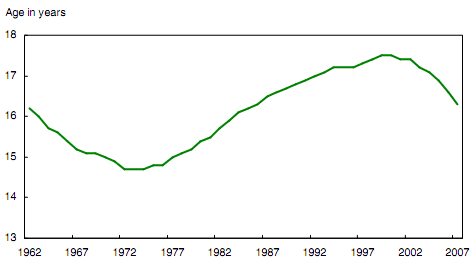
The average age of Canada's public infrastructure-its highways and roads, bridges and overpasses, water supply systems, wastewater treatment facilities and sanitary and storm sewers-has been falling as a whole for the past seven years. In 2007, it reached 16.3 years, down from its peak of 17.5 in 2000.
This rejuvenating trend was fuelled largely by higher investments in the network of highways and roads in Quebec and Ontario in recent years.
A reduction in the average age is indicative of a general trend toward younger stock of investments. It doesn't imply necessarily that each physical asset is younger or in better conditions or that a greater proportion of assets meets specific quality standards.
The amount of investment-and the corresponding average age-that would be required to ensure that all assets comply with a given quality level can only be determined based on appropriate engineering methods. Quality levels depend on several factors, including public health and safety regulations and competing demands on government available resources.
In Canada, the majority of investments in public infrastructure were done during the 1950s, 1960s and early 1970s. In the beginning of the 1970s, the average age of public infrastructure hit an all-time low of 14.7 years. This major expansionary period was followed by more modest investments during the 1980s and 1990s when needs for major repairs or additions were less pressing. By the turn of the millennium, the average age of public infrastructure had then risen to an all-time high of 17.5 years.8
Chart 1 Public infrastructure on a rejuvenating trend since 2001
Source: Statistics Canada, special tabulation, Investment and Capital Stock Division.
Research has demonstrated that countries with modern, safe and efficient infrastructure are more productive and more competitive on international markets. 9 As a result, citizens enjoy higher quality of life stemming from economic growth. However, the development and maintenance of public infrastructure require heavy and steady investments of public funds.
In 2000, investments in public infrastructure experienced resurgence, halting the ageing trend. This stabilized the average age of the total stock at 17.5 years in 2000. Major sustained investments thereafter prompted a drop in the average age to 16.3 years in 2007, which was equivalent to the average two decades earlier. From 2001 to 2007, total public infrastructure stock increased 5.3% in 2002 constant dollars. During this same period, total population grew 6.3% and real gross domestic product rose an average of 2.3% per year.
__________________________________________________________________________________
8. For more information about national trends including the distribution of public assets by level of government, see Valérie Gaudreault and Patrick Lemire, "The Age of Public Infrastructure in Canada," Analysis in Brief, 2006, Statistics Canada Catalogue no. 11-621-MWIE2006035, http://www.statcan.ca/english/research/11-621-MIE/11-621-MIE2006035.htm (accessed December 7, 2007).
9. See Tarek Harchaoui, Faouzi Tarkhani and Paul Warren. "Public Infrastructure in Canada, 1961-2002," Canadian Public Policy, vol. 30, no. 3, September 2004, pp. 313-318.