Sanitary and storm sewers on a continuing ageing trend
The responsibility for sanitary and storm sewers rests with municipal governments. However, funding for upgrading or expanding current sewer systems is a matter joint partnership between the various levels of governments and sometimes the private sector.
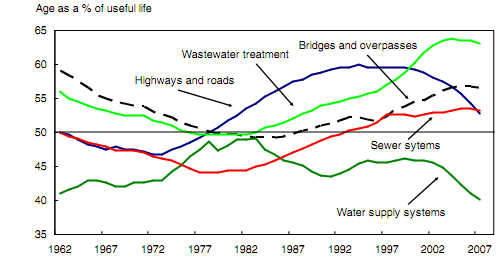
In Canada, the value of the gross stock of sanitary and storm sewers amounted to $36.0 billion, or 13% of the five assets. This was the second largest public asset after highways and roads. This stock has been growing at an average annual rate of 1.0% since 2001. However, despite this growth, the average age continued to climb reaching its all-time high of 18.0 years in 2006. In fact, this asset has been ageing almost steadily since 1977 with the exception of 2007 when the average age dropped marginally to 17.9 years.
The average age grew slightly in all provinces except Ontario, Manitoba, Saskatchewan and Alberta. The overall moderate ageing trend was fuelled mainly by Quebec, where the average rose from 17.3 in 2001 to 18.1 years in 2007, and British Columbia, where it edged up from 16.6 to 16.9 years during the same period. In 2007, these facilities had passed 53% of their useful life (which is 33.6 years on average) nationally; three decades earlier, this proportion stood at 44%.
Chart 3 Useful life expended highest for water treatment infrastructure since 2000
Source: Statistics Canada, special tabulation, Investment and Capital Stock Division.