I. What is the Municipal Infrastructure Deficit?
Municipalities build, own and maintain the majority of this country's infrastructure-infrastructure that supports our economy and quality of life.
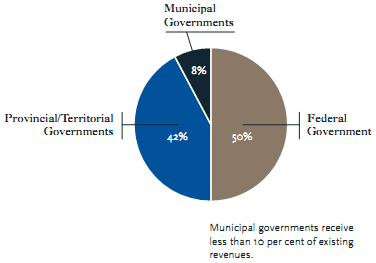
During the past 20 years, Canadian municipalities have been squeezed by increasing responsibilities and reduced transfer payments from other orders of government. This has had direct and negative consequences for Canada's infrastructure. Unlike other orders of government, municipalities are not allowed to run deficits on their operating budgets. This, in turn, has put tremendous downward pressure on municipal capital budgets, which do not face the same immediate pressures as operating expenditures, making capital investments easier to delay. This has fuelled the growth of a substantial national municipal infrastructure deficit.
This infrastructure deficit affects our communities in a number of ways. Municipal governments are finding it extremely difficult to manage current infrastructure demands, let alone deal with the accumulated backlog of infrastructure maintenance and rehabilitation. This is compounded by population growth, which further strains existing infrastructure resources while creating additional demand for more infrastructure.
We can see the consequences in every community: potholes and crumbling bridges, water-treatment and transit systems that cannot keep up with demand, traffic gridlock, poor air quality and a lack of affordable housing. The infrastructure deficit affects all communities, from major cities to rural, remote and northern communities, where municipal governments lack essential infrastructure and do not have the tax base to develop it.
Across Canada, municipal infrastructure has reached the breaking point. Most was built between the 1950s and 1970s, and much of it is due for replacement. Given municipalities' already strained fiscal situation, we are rapidly approaching a tipping point on the infrastructure deficit, one that will seriously harm both our quality of life and our competitiveness and productivity.
Figure 1
Municipal Government Share of All Tax Revenues
Source: FCM, 2006
THE MUNICIPAL INFRASTRUCTURE |
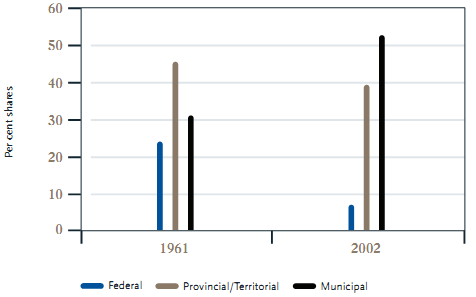
In 1961, during the initial phase of heavy investment in Canada's infrastructure, federal, provincial/territorial and municipal governments each controlled 23.9, 45.3 and 30.9 per cent of the national capital stock, respectively. By 2002, the federal government's share had dropped from 23.9 per cent to 6.8 per cent, and the municipal share had grown from 30.9 to 52.4 per cent of all infrastructure, an increase of nearly 70 per cent.
Figure 2
Public Capital Stock in Canada
_________________________________________________________________________________
Source: FCM, Building Prosperity from the Ground Up: Restoring Municipal Fiscal Balance (2006), p.37. (Taken from a chapter authored by Roger Gibbins, Canada West Foundation, and Mario Lefebvre, Conference Board of Canada)