II. What Does the Municipal Infrastructure Deficit Include?
In formal terms, the municipal infrastructure deficit refers to the following:
• the unfunded investments required to maintain and upgrade existing, municipally owned infrastructure assets; and
• the funding needed over and above current and projected levels to bring existing facilities to a minimum acceptable level for operation over their service life, through maintenance, rehabilitation, repairs and replacement.
More simply, the municipal infrastructure deficit is an estimate of the total additional investment needed to repair and prevent deterioration in existing, municipally owned infrastructure assets.
This report focuses on the same broad infrastructure categories that have typically been included in the municipal infrastructure deficit. These assets fall into five categories :
1. Transportation (roads, bridges, curbs, sidewalks);
2. Water infrastructure (distribution, supply and treatment);
3. Wastewater systems (sanitary and storm sewers and related treatment facilities);
4. Transit systems (facilities, equipment and rolling stock); and
5. Other public infrastructure (including cultural, social, community and recreational facilities; and waste-management facilities).
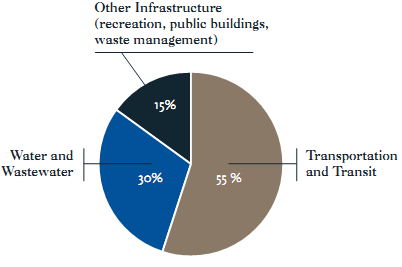
These five categories-water, wastewater, transit, transportation and other public infrastructure-include most municipal capital assets. As of 2000, municipal transportation and transit infrastructure comprised 55 per cent of total municipal infrastructure, while water and sewer infrastructure comprised another 30 per cent, and recreational facilities, waste management, public buildings and others comprised the remaining 15 percent5
Figure 3
Canada's Municipal Infrastructure Stock (2000)
__________________________________________________________________________________
5 Tarek M. Harchaoui, Faouzi Tarkhani and Paul Warren, Public Infrastructure in Canada: Where Do We Stand? (Ottawa: Statistics Canada, 2003).