I. Literature Review
Over the past decade, a number of studies have examined Canada's infrastructure needs.
• In 2003, the Canada West Foundation estimated the total deficit for all public infrastructure in Canada was as much as $125 billion;10
• In a 2003 study, Mirza and Haider found that the infrastructure deficit for all public assets in Canada stood at $125 billion and could reach $400 billion by 2020.11
The most widely cited estimates of the municipal infrastructure deficit have been based on previous municipal surveys:
• Surveys undertaken by FCM and McGill University show a municipal infrastructure deficit that grew from $12 billion in 1985 to $44 billion in 1996 (see Figure 4).
• An update of previous survey results by the Technology Road Map, and the Canadian Society of Civil Engineering (CSCE), Canadian Council of Professional Engineers (CCPE), Canadian Public Works Association (CPWA) and the National Research Council of Canada (NRC), placed the municipal infrastructure deficit at $57 billion in 2003.12
• In 2002, TD Economics estimated that the municipal infrastructure deficit was growing by $2 billion a year;
Figure 4
Municipal Infrastructure Deficit Estimates
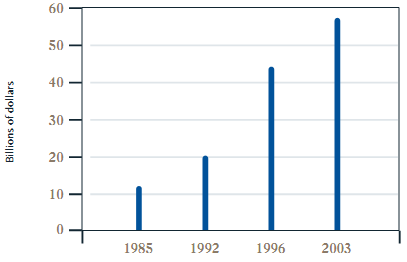
These studies all point to a massive and growing backlog of municipal infrastructure requirements. Since 2003, the most widely cited estimate has been about $60 billion. The infrastructure deficit is commonly believed to increase by $2 billion a year,13 as calculated by TD Economics in 2002, which represents a modest degree of deterioration over a short period (such as five years).
__________________________________________________________________________________
10 TD Bank Financial Group, Mind the Gap, Finding the Money to Upgrade Canada's Aging Public Infrastructure (2004), p.5.
11 M. Saeed Mirza and M. Murtaza Haider, The State of Infrastructure Policy in Canada (2003).
12 CSCE, CCPE, CPWA and National Research Council Canada, Technology Roadmap: 2003-2013 (2003).
13 The 2007 FCM-McGill survey has shown that this estimate was too conservative.