THE LIMITATIONS OF EXISTING ESTIMATES
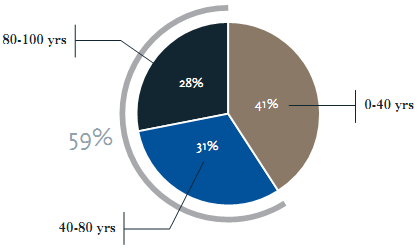
There are reasons to believe that current estimates are due for a significant revision. The most obvious shortcoming is their failure to account for the effects of rapid aging and escalating deterioration on certain categories of infrastructure. Age significantly affects future needs and the resulting infrastructure deficit. According to the Technology Road Map (TRM),14 only about 41 per cent of Canadian infrastructure is 40 years old or less. The age of 31 per cent of the assets is between 40 and 80 years, while the remaining 28 per cent is more than 80 years old. TRM found that Canada has used up about 79 per cent of the total service life of its public infrastructure. Moreover, it should be noted that infrastructure deterioration accelerates with age.
Figure 5
Age of Canada's Infrastructure (Years)
Under such conditions, the costs of upgrading a more severely deteriorated infrastructure asset to an acceptable level would multiply many times the funding required to upgrade the asset before it deteriorated. In some cases, it may not be possible to rehabilitate the asset. This would require the asset to be decommissioned, its debris removed, and a replacement built at a much higher cost.
Many other factors affecting infrastructure needs, and the infrastructure deficit, are not effectively captured in existing estimates. Some of these are the following:
• Demographics: Often smaller communities require larger per capita expenditures on infrastructure. However, larger urban centres have extensive transportation and transit systems and rapidly deteriorating water supply and wastewater disposal systems that require significant investments.
• Geography: A community's location significantly affects its infrastructure needs, especially if those communities are northern, rural or coastal.
• Local needs: Changing socio-economic and environmental conditions partly determine the infrastructure investments needed in a community.
• Climate change: Extreme weather is putting new strains on infrastructure, accelerating aging and deterioration and increasing the risk of failure.
• Economics: In deciding on needed investments, inflation, currency fluctuations and the cost of construction materials and labour must be considered.
Studies by the Canadian Water Network (CWN),15 the Canadian Water and Wastewater Association (CWWA),16 and the Canadian Urban Transit Association (CUTA)17 point to larger-than-ever deficits in water and wastewater facilities and transit systems. Taken together, these and other findings suggest the municipal infrastructure deficit has far surpassed previous estimates.
__________________________________________________________________________________
14 CSCE, CCPE, CPWA and National Research Council Canada, Technology Roadmap: 2003-2013 (2003).
15 Canadian Water Network (CWN), 2004-2005 Annual Report, Bringing Water Research to Life (2005).
16 Canadian Water and Wastewater Association (CWWA), Municipal Water and Wastewater Infrastructure: Estimated Investment Needs 1997-2012 (1997).
17 M. Cautillo, An Opportunity to Meet Transportation Needs: Building a Better, Stronger Business Case (Deloitte & Touche LLP, 2004).