Discussion
Among the key findings of the 2007 survey are the following:
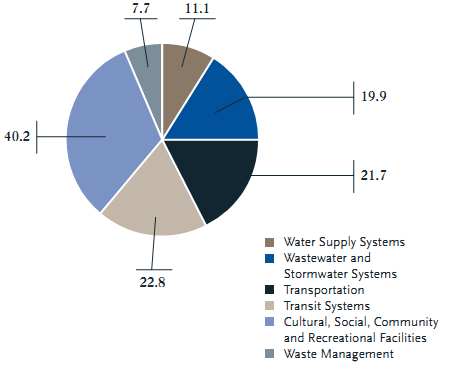
• Cultural, social, community and recreational facilities are aging and have deteriorated considerably. Lack of capacity is also a pressing issue. Some municipalities have dealt with the crisis by investing considerable funds in dealing with the problem. However, many others have directed capital dollars toward other pressing infrastructure needs (water, wastewater, transportation) and must now make overdue investments in these areas. The deficit in existing infrastructure for this category is now estimated to be $40.2 billion, compared with the 1996 deficit of $7.55 billion.
• Water supply, wastewater and stormwater systems are approaching the end of their service life, especially in older communities. The municipal infrastructure deficit for these categories stands at $31 billion, a 47 per cent increase since 1996, when the deficit was estimated at $21 billion.
• Significant funding is needed to address deteriorating transportation assets. The funding gap for existing infrastructure has grown from $10.75 billion in 1996 to the present $21.7 billion.
• Canada's urban transit systems were built mainly in the 1960s. Deterioration has been considerable, and many facilities need to be repaired or rehabilitated. Transit fleets need considerable investment. The municipal infrastructure deficit for this category was estimated at $3.05 billion in 1996. Based on the 2007 survey, the deficit in this category has increased dramatically to $22.8 billion.
• The waste-management deficit has also increased significantly, from about $1 billion in 1996 to $7.7 billion today.
Figure 8
Municipal Deficit for Existing Infrastructure by Category
(Billions of Dollars)
• The growth trend of the municipal infrastructure deficit in the last two decades has reached crisis proportions. In 1985, the estimated deficit was $12 billion, which may have been conservative due to the overall lack of information about existing infrastructure. Canada's infrastructure deficit reached $44 billion 10 years later, according to the 1996 FCM-McGill survey.
• When set beside earlier estimates, the $123-billion figure clearly shows the municipal infrastructure deficit is growing faster than previously thought.
• In 2003, the Technology Road Map estimated that the municipal infrastructure deficit stood at $57 billion. However, unlike studies in 1985, 1996 and 2007, the 2003 estimate was not based on new survey data.
• The new survey reveals a considerable increase in unmet needs for existing infrastructure, which stand at about $123 billion. The survey included a more comprehensive list of assets in each category. However, the infrastructure covered by the survey questionnaire was consistent with the previous FCM-McGill 1996 survey for comparison purposes.
• The three different survey estimates clearly illustrate the deficit's tendency to compound. This can be attributed to the accelerated aging of some infrastructure assets and considerably increased deterioration due to deferred maintenance, lack of quality control in construction and fabrication of materials, and, in several cases, harsh climate and aggressive environments for which the infrastructure was not properly designed, operated and maintained.