From Deferral to Disaster: Compounding Capital Needs
By definition, infrastructure spending relates mainly to long-lived capital assets. Capital investments have inherent long-term characteristics: investment in new infrastructure must include plans to repair and eventually replace the asset.
As infrastructure investments declined in the late 1970s and 1980s, maintenance, repair and rehabilitation activities were often deferred, even at the risk of jeopardizing assets and reducing their service life. Reversing this neglect is much more expensive than regular maintenance, so much so that it may not be possible to rehabilitate an asset, which instead must be decommissioned, demolished and constructed anew at an exorbitant cost to the taxpayer.
One of the principal causes of the extensive deterioration of Canada's infrastructure is deferred maintenance during fiscally difficult times. It is instructive to examine the influence of maintenance on the quality of performance and service life of a typical infrastructure asset. The qualitative influence of four different levels of annual maintenance rates-ranging from "no maintenance" (which would be the case with deferred maintenance) to two per cent of the asset's construction cost, which would normally keep the asset in an acceptable operating condition with on-going low-cost regular maintenance- is shown in Figure 9.
Figure 9
Infrastructure Condition as Determined by Maintenance
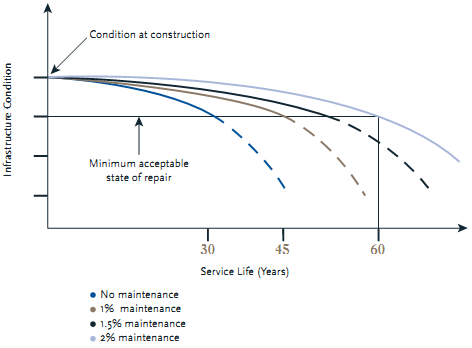
Note that with no maintenance or sporadic deferred maintenance, the infrastructure facility deteriorates very rapidly and with a considerable reduction in its service life. However, if about two per cent of the facility cost is invested in its maintenance, the deterioration rate is much slower, and a considerably longer service life is achieved. This clearly highlights the importance of both maintaining the infrastructure facility adequately and not deferring maintenance under any circumstances.
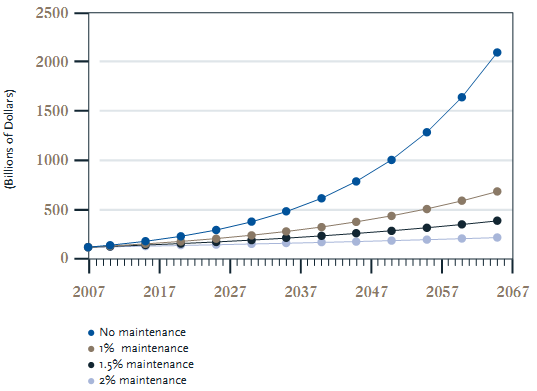
The influence of the four levels of maintenance on the escalation of the municipal infrastructure deficit over the next 50 years is demonstrated in Figure 10. Note that without maintenance or with deferred maintenance, the municipal infrastructure deficit could be close to $2 trillion by 2065. However, with regular maintenance and good scientific management, the escalating infrastructure deterioration and the resulting infrastructure deficit can be controlled within manageable levels. In other words, our infrastructure will grow old (that is, attain its service life and beyond) gracefully (in a reasonable condition requiring inexpensive routine maintenance). Alternatively, the cost of the actions needed for renewal of our municipal and other infrastructure would be so high that governments would not be able to cope with them.
More research is required to establish the current rate of investment in infrastructure maintenance, repairs and rehabilitation. However, all available evidence suggests it is below the level required to keep municipal assets in good repair.
Figure 10
Municipal Infrastructure Deficit: Projected Growth