3.2.3 Development of an output specification
The output specification underpins the entire public private partnership procurement process. The purpose of an output specification is to comprehensively and accurately state the outcomes required from the process, i.e., the identified service requirements.
The focus of an output specification is on services required rather than assets wanted, and the service standards expected by government, regardless of who will deliver the services. Output specifications should be clear, unambiguous statements of what is needed, not how it is to be provided. It is generally acknowledged that the development of output specifications will require significant expertise. It is important that the output specification is clearly defined and quantifiable, as it will become the foundation for indicators against which performance will be measured and payment made. This is necessary in order to achieve a clear and unambiguous contract structure for the payment of services and satisfaction of service requirements.
The agency should be indifferent as to how a particular service requirement is met, provided that the required service standard is achieved in a timely and cost effective manner. It may be prudent however, depending on the nature of the project, to ensure that certain minimum design and construction criteria are complied with, rather than rely on payment or penalty mechanisms alone for a guarantee of performance.
The team developing the reference project should also be involved in the drafting of the output specification to ensure that the reference project reflects the output specification.
The output specification should be drafted in such a manner to ensure that it captures relevant 'value for money' drivers initially identified in the preliminary assessment. It would, for example, be inappropriate to limit the provision of a service to a timeframe too short to enable the private sector to generate sufficient income to present a value for money delivery option to government.
For sample output specifications refer to Appendix 3.
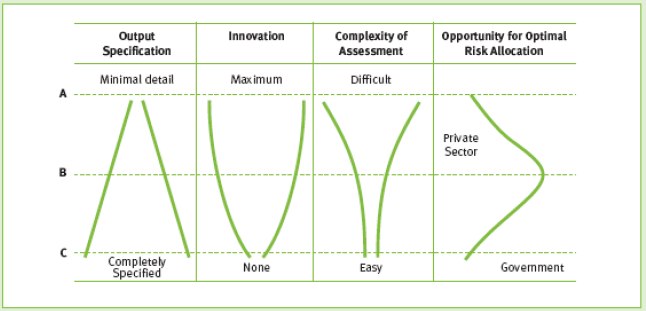
Determining the level of detail required in the output specification requires striking a balance between allowing the private sector scope to generate a value for money delivery option through innovation and risk allocation, and the complexity of the assessment required to determine the best value for money bid. In general, as more detail is added to the output specification, the assessment becomes easier and the scope for innovation decreases. In addition, the opportunity for optimal risk allocation is best achieved at a point part way along this continuum (figure 3).
Figure 3- Competing requirements for detail in Output Specification Take for example an educational facility. At Option A, the specification may contain no more detail than, "a college for Queensland". This level of specification provides the Private Sector with significant scope for Innovation in service delivery. However, given the widely variant nature of the bids that are likely to be developed, assessment of each bid against another and against the actual requirements for the project will be almost Impossible at this stage. This level of detail would also see the Government maintaining significant risk as to the functionality and consistency with Government's requirements for core service support. Conversely, Option C represents an overly detailed Output Specification, Including everything down to the specific screws to be used In the cupboard door. While this level of detail Is likely to promise easy comparison between delivery options, It also will severely limit the opportunity for the Private Sector to achieve an Innovative value for money delivery option. At this level of specification, Government will retain the bulk of the risk associated with the suitability and functionality of the facility. Option B, however, represents an Output Specification that presents a balance between these extremes. It provides specification on what is required in terms of, for example, teaching space and support facilities, but not Information on how such facilities are to be provided. This allows the Private Sector opportunity to deliver an innovative approach to the 'how' of service provision, and give them scope to carry the associated service provision risks. This level of detail In the Output Specification will allow for a like-with-like assessment of measurables that Government has established as specific requirements of the project. It also provides significant scope for effective risk allocation |
The value for money framework outlines a number of items that should be included in an output specification. Additional items also worthy of consideration for inclusion in a specification are as follows:
Structure | Content |
Project description | Policy outline and contracting requirements statement. |
Organisation outline Stakeholder requirements | Structure of organisation and project interfaces. Schedule of stakeholder requirements, for example, expectations of core service providers. |
Scheme objectives | Strategy outlined in preliminary report/Profile business case and purpose of project-What it is to achieve? |
Performance standards and monitoring | Required operating performance in output terms, with details of monitoring requirements. |
Quality standards | Minimum asset quality criteria, codes and standards. |
Constraints | Constraints essential to an acceptable solution, including environmental, stakeholder or other minimum requirements. |
Payment criteria | Basis on which payments may be made (availability, use, flexibility, and performance). |
Change mechanisms | Provision for change in load conditions, etc. |