Sensitivity analysis
Sensitivity analysis is a technique used to consider the effect on the whole project of changes in the value of each of the value for money drivers. The analyses involve repetitive calculation of the effects on the project outcome of a range of values of the variables that generate value for money. project outcome is usually considered in terms of overall value for money, expressed as the difference in net present value between the public sector comparator and the partnership model.
The results of sensitivity analyses can most usefully be shown graphically on a spider diagram. Figure 7 shows how changes in the above-mentioned key variables for the model impact on the total net present value. Steeper gradients indicate that the net present value is more sensitive to changes in this variable relative to the other variables tested.
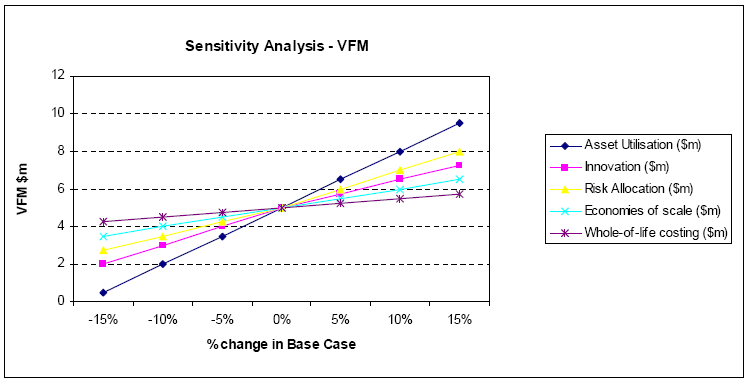
Figure 7-Sensitivity analysis
This example is based on an analysis of the possible overall value for money, which itself is based on the most likely cost outcome for the leisure centre example. The spider diagram represents the sensitivity of the overall outcome, and changes in the variables identified in the partnership model. For instance, it indicates that, for this project, the overall value for money is particularly sensitive to asset utilisation (as indicated by the steepness of the gradient of the asset utilisation graph compared to the other drivers). In comparison this project is relatively insensitive to whole of life costing.
The technique is very useful as the effect of a small change in one variable (in this case, asset utilisation) often produces a marked difference in the value for money outcome. Sensitivity analysis can also be extended to look at the individual variables that comprise the project, for example:
• capital costs
• operating and maintenance costs
• refurbishment costs
• discount rate
• inflation rate
• equity rate of return.
Sensitivity analysis is particularly useful in determining the variables that have a significant impact on the value for money outcome. Sensitivity analysis can therefore provide support for the qualitative assessment and indicate whether there is potential for a public private partnership project delivery option to represent a value for money outcome. It also provides a focus on the areas that critically impact on value for money, as shown in the example above, where sensitivity analysis highlighted the importance of asset utilisation for the project in question.
A limitation of sensitivity analysis is that each variable is considered independently, with no attempt made to quantify their combined impact or the extent to which ranges are achievable.