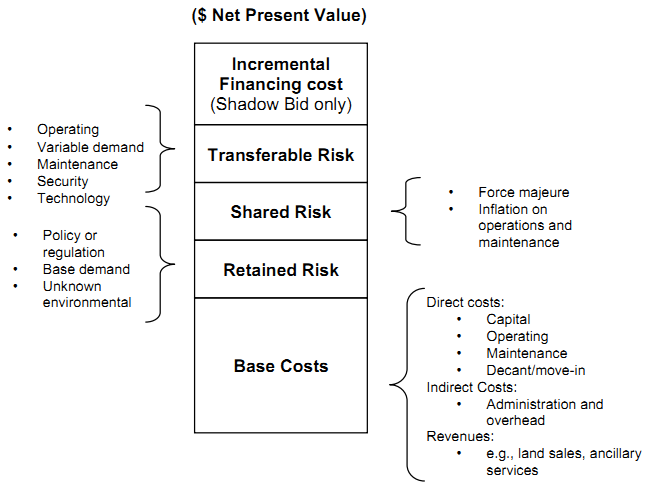
5.4.3.3 Components of the PSC and Shadow Bid
The PSC and Shadow Bid are made up of the following costs:
• Base Costs - represents the base cost to government of producing and delivering the project including those costs associated with design, construction and operation. In addition it should include those periodic costs associated with the delivery of services (e.g. major maintenance, rehabilitation and replacement of components). These base costs are generally the same between procurement alternatives.
• Retained Risk - those risks that government proposes to bear itself. The retained risks will vary between procurement approaches.
• Shared Risk - those risks that are jointly shared with government and private sector. The shared risks may vary between procurement approaches.
• Transferable Risk - those risks that are likely to be transferred to the private sector because they are best able to manage the risk and potentially at a lower cost. The transferable risks will vary between procurement approaches.
Financing Costs - the incremental cost of private financing for the P3 over GOA's cost of borrowing is included in the Shadow Bid.
The PSC and Shadow Bid are the Net Present Value (NPV) of each component added together to establish the total net present value of the procurement option.
The Ministry of Treasury Board may be consulted for further understanding/clarification around NPV and the discount rate used in calculating NPV. (See "Common questions about P3s in Alberta": http://www.treasuryboard.alberta.ca/1159.cfm.)
Figure 2: Components of the Public Sector Comparator (PSC) and Shadow Bid