Introduction
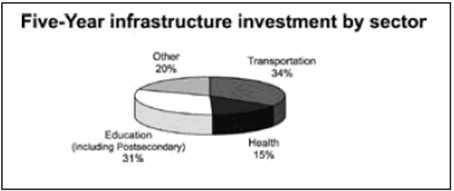
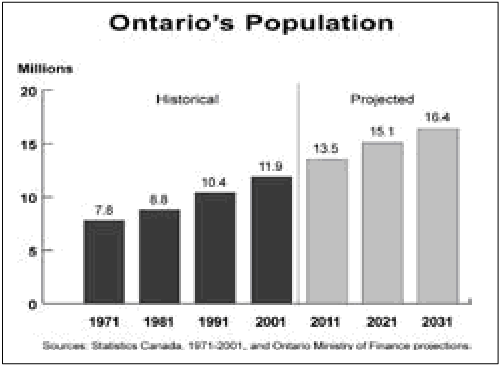
Public infrastructure is essential to every person in Ontario and critical to the competitiveness of our economy, the quality of life we enjoy and the delivery of public services. But past neglect and the need to accommodate millions of new people who will settle in Ontario over the next 25 years have created substantial challenges. This document provides strategic highlights of the five-year plan by the government and its partners to invest more than $30 billion in Ontario's public infrastructure by the year 2010.F
| The Challenges: The infrastructure deficit | • The average age of our hospitals is more than 40 years, which means many are reaching the end of their useful life and must be modernized or replaced. |
|
|
| • Many of our 3,990 elementary and 853 high schools were built in the 1920s; problems such as leaky roofs, inefficient heating systems and mouldy classrooms in some schools must be addressed so they do not create a barrier to student success. • Highway 401 across Toronto is the busiest highway in North America and operates at close to capacity for most of each day. • Some Ontario jails were built in the 1800s and some courthouses are more than 75 years old. Many of these buildings don't have the capacity and capability to meet today's requirements. The scope and scale of the infrastructure deficit are enormous. The cost of redressing past neglect by modernizing and replacing many of the province's roads, highways, hospitals and schools, as well as building new ones to accommodate growth, may be more than $100 billion. Yet the importance of public infrastructure to our economy and our quality of life is indisputable. A prosperous economy depends on a healthy and well-educated workforce, the delivery of accessible, top-quality services and the orderly growth of our communities. |
|
| The Solutions: A five-year infrastructure investment plan | The government has already taken steps to ensure that growth is planned and managed strategically through its Places to Grow initiative and proposed growth legislation that will enable the development of growth plans for specific areas of the province.
| |
|
| To ensure that all Ontario will continue to have a prosperous and promising future, the government is implementing a strategic five-year plan to make new investments in our public infrastructure. Ontario's economy depends on the strength of our people, and our people depend on infrastructure that is modern, reliable, efficient and affordable. Providing the highest-quality infrastructure at the lowest possible cost demands a more innovative, principled and effective method of managing public infrastructure investments. In the past, Ontario's infrastructure investments were made on a year-by-year basis, with little attempt to co-ordinate capital projects across government ministries or economic sectors. The principal source of funding was the government, and most projects were funded from current revenues, with the entire cost counted during the construction of the project, not paid for over the life of the asset. The infrastructure challenge is formidable. The government requires more innovative and more flexible investment and project management strategies to meet the test - and to ensure on-time, on-budget project delivery. While the provincial government will continue to take the leading role in funding public infrastructure, we will broaden our infrastructure strategy to include partnerships with the broader public-sector, including Ontario public pension funds and the private sector where and when it makes sense. Over the next five years, the government and its partners will invest more than $30 billion in public infrastructure. This investment represents the first step in a long-term plan to renew public infrastructure in Ontario. And it is accompanied by major improvements in the way these investments are planned and managed: • Infrastructure investments are being planned over a longer period to support major priorities in health care, education and economic growth. • Infrastructure investments are being co-ordinated with partners in the broader public sector - federal and municipal governments and public agencies such as universities, school boards and hospitals - so that we work with a common set of priorities and towards a common set of outcomes. • New sources of investment will be used to finance public infrastructure, including private-sector investors, pension plans and Ontario residents themselves through provincial infrastructure renewal bonds. New ways of harnessing the experience and expertise of the private sector will be employed. • All major infrastructure projects will be subject to the principles of the government's infrastructure planning, financing and procurement framework and its broadened investment strategy, regardless of their current status. • Most public infrastructure will be funded through direct investments by the government; with approximately 10 per cent of the funding coming from alternative financing sources. • Better ways of planning, procuring and financing public infrastructure will be used from this point forward, and better ways of managing public assets have been instituted to extend their useful life.
• By amortizing infrastructure assets, the government can expense their cost over time: 15 years for an average section of highway, 60 years for a bridge and 40 years for buildings. This means we can begin much-needed projects earlier. • Infrastructure investments are being co-ordinated with land use and development under the government's Places to Grow initiative to maximize use of existing infrastructure and encourage growth in areas that can best accommodate it. | |
| Investment sources: Financing Ontario's Public infrastructure renaissance | The government is acting strategically to concentrate investments in areas that Ontarians have said are their priorities: health care, education and economic prosperity. The more than $30 billion that Ontario and its partners will invest in infrastructure over the next five years will ultimately come from the public. While the financing for some large projects will initially come from the private sector, all of it will be repaid from public funds over time and the public will control the assets it builds. |
|
| These are the funding sources: • The largest component - about $18 billion, including about $2 billion from the federal government under current commitments - will be Ontario's gross capital investment. It will be invested in key government priorities: renewing and modernizing hospital; upgrading and expanding our highways and transit systems; creating new affordable housing; providing support for key infrastructure in northern Ontario; and improving municipal water systems, bridges and roads across the province. • Over $5 billion will be provincial operating grants to transfer partners such as school boards and long-term care facilities for infrastructure renewal and expansion. • Approximately $4.8 billion will be for education to support repairs and new construction in the school system and to finance new undergraduate and medical and graduate school enrolment expansion at universities. • About $1.4 billion from the provincial government's gas tax revenues will be directed to municipalities to improve public transit and increase transit ridership. • About $2.3 billion will come from major alternative financing and procurement arrangements for large-scale projects in hospitals, the justice sector and other areas.
|