Forecasting future service demand and recent experience
RCH service demand projections were based on forecast numbers in the RCH Service Plan (2004) and Service Plan Review (2005). These service plans reflected the broader forecasts of future service demand in the 2003 Metropolitan Health Strategy.
A key data source used in the service planning process to forecast future service demand was a declining birth rate forecast made by ABS. This was the most appropriate and up to date data source at the time.
However, the RCH Service Plan (2004) did not specify the actual forecast decline in the birth rate applied, and DHS was not able to confirm the rate used. The 2004 service plan also indicated that while historical evidence showed a decline in the birth and fertility rates over the last few decades, this was due to an increase in the total population of Victoria, not a decline in the total number of births. So while the birth rate was dropping, the overall population was increasing-meaning an overall increase in the total number of births.
Our review of more recent population trends found that the assumptions underlying population growth forecasts have changed since the time of the RCH service planning and are likely to continue to change over time:
• The actual birth rate over the five years from 2001 to 2005 increased rather than decreased. ABS data suggests that based on the number of registered births in Victoria, the average birth rate increased by 1.39 per cent per year in that period.
• The birth rate has historically fluctuated in a cycle and is currently at a peak but may subsequently decline.
• Levels of immigration and economic growth in Victoria are linked, and can fluctuate rapidly, and therefore can have a rapid impact on the birth rate.
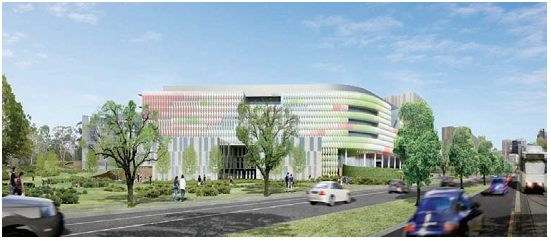
An artist’s impression of the Flemington Road frontage of the new hospital.
(Image courtesy of Billard Leece Bates Smart and Sharp Design)
As part of the audit we sought analysis by DHS or RCH of the impact of new census data on the projected demand for paediatric services and the number of beds required on a statewide basis and at RCH. DHS was awaiting updated detailed population forecasts from the Department of Planning and Community Development, expected in early 2009, before undertaking detailed work in this area, but did provide the results of preliminary analysis undertaken in October 2008.
That analysis involved a simple projection, using 2006 ABS census data and ABS data on the 0-14 age population, to forecast demand for paediatric services and the number of beds required on a statewide basis. The projection indicated that the state will need an additional 50 beds, over and above existing capacity, to meet expected future demand by 2016, when service demand is expected to plateau.
DHS is confident that this projected demand increase can be accommodated on a statewide basis given that the new RCH will have 50 more beds than the existing hospital and there is sufficient flexibility, 'shell space' and other design options for capacity expansion in the new RCH to provide a further 53 beds.
This is before taking into account any other investments in paediatric services in Victoria apart from the RCH.
DHS' October 2008 analysis did not address how many of the additional required beds would be provided by RCH and other providers of paediatric services in the state.
DHS has demonstrated that flexibility in the design of the new RCH should be able to handle currently projected increases in service demand that were not anticipated during the service planning stages for the new RCH.
However, DHS has not yet performed any analysis, or provided any advice to government on when any additional beds provided by the expansion capacity of the new RCH (such as fitting out shell space or reconfiguring the internal design), may need to be delivered.