4.3.2 Feasibility study for the new hospital
A feasibility study is typically a preliminary study undertaken to determine a project's viability. The results are then used to make a decision on whether or not to proceed with the project.
The RCH service plan indicated that a feasibility study was to be prepared detailing the capital development options after the SBC or investment evaluation but prior to the development of the preliminary and final business case.
A feasibility study which formed part of a larger development options report was completed in November 2005, at the same time the business case was finalised and approved by government. A Gateway review in October 2005 of the preliminary business case found that the feasibility study remained incomplete but this was addressed by November 2005.
While the feasibility study was not finalised until November 2005, the government considered the outcomes of the feasibility study progressively from September 2005, as they related to selection of a preferred site.
The development options report formed the basis for the final business case submitted to government and included detailed and comprehensive analysis of the various options for the redevelopment of RCH.
There were five site redevelopment options considered in the feasibility study. Each of the five redevelopment options provided for approximately 96 000 square metres of hospital space and 2 000 car spaces.
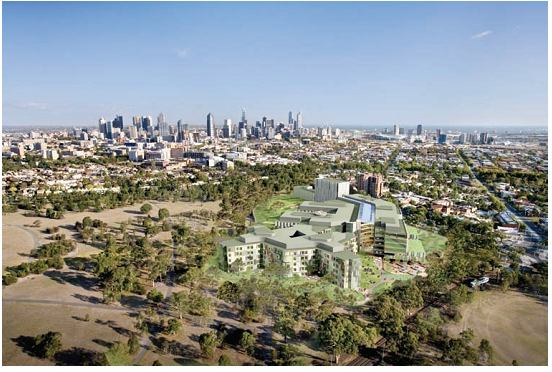
An artist’s impression of the RCH campus after construction and park reinstatement.
(Image courtesy of Billard Leece Bates Smart and Sharp Design)
The options considered are outlined in Figure 4B along with preliminary cost estimates presented to government in early October 2005.
| Figure 4B | ||
|
Site option |
Option outline | Preliminary cost estimate ($ million) |
| Docklands | A new facility on a four hectare site on Footscray Rd at Melbourne Docklands. | 831 |
| New west | An entirely new facility built on the Royal Park oval adjoining the western boundary of the existing site. On completion, all existing RCH buildings and car parks would be demolished and the site returned to parkland with no net loss of parkland. | 755 |
| New west variant | A new facility built on the Royal Park oval adjoining the western boundary of the existing site. Approximately 10 000 square metres would be retained in the existing RCH/MCRI research building and front entrance building. On completion, some existing buildings and the RCH car park would be demolished, and the eastern half of the current site restored to parkland with no net loss of parkland. | 721 |
| West integrated | New clinical areas built on the Royal Park oval adjoining the western boundary of the existing site with research and non-clinical functions retained in existing buildings. On completion of construction, the existing RCH car parks and south east building would be demolished, and the eastern half of the current site restored to parkland. There would be no net loss of parkland. | 711 |
| East integrated | Similar to the West Integrated option and involves construction of new clinical areas on the eastern side of the existing site with research and non-clinical functions retained in existing buildings. | 779 |
Source: Victoria Auditor-General's Office, using data provided by DHS.
The preliminary cost estimates for each of the options shown in Figure 4B are net of an expected funding contribution of $90 million from the RCH. The RCH funding contribution was expected to be sourced from a combination of borrowings ($30 million), asset sales ($10 million) and a funding commitment of $50 million from the RCH Foundation.
These preliminary cost estimates were presented to government in early October 2005 as part of a submission recommending selection of a site option for the new RCH. On the basis of that submission, on 6 October 2005 the government approved the selection of the 'new west variant' as the preferred site option.
This approval was subject to finalisation of the business case and a number of conditions relating to:
• funding
• capping of gross floor area and site boundaries
• the return to parkland of an area at least equivalent to the parkland to be used for the redevelopment
• potential use of existing buildings in the redevelopment.