Contract management
The Partnerships Victoria guidance requires development of a contract management plan (CMP) as the first step in developing and maintaining an effective contract management strategy. Specifically, the CMP covers all material areas of contract administration under the project agreement and is the precursor and foundation for the development of the contract administration manual (CAM).
The guidance requires:
• an initial CMP to be developed (and with sign-off obtained from senior management) early in the procurement process prior to the commencement of the CAM
• a final CMP (even before the completion of the CAM) should be completed as soon as possible after the execution of the contract and during the transition from procurement to contract management
• a final CMP, including details of the CAM, should be submitted to government within three months of contract execution to inform government of the proposed contract management strategy.
These requirements were met for the RCH project and a final CMP, including an outline of the CAM, was submitted to government in early 2008, which was within three months of completion of the contract for the project.
The Partnerships Victoria guidance states that the implementation of a CMP-by the development of an effective CAM-is a key activity for the state during the procurement phase of the project and the transition from the procurement phase to construction and service delivery.
The guidance is equally clear that a CAM should be developed to assist the contract management function during the design and construction phase of the project. This was reinforced in an addendum to the Partnerships Victoria Contract Management Guide during September 2008 which was made in response to a recommendation made in our June 2008 report to Parliament on the new Royal Women's Hospital PPP project1.
The CAM is a centralised collection of documentation for all the tools and processes used in managing the contract and should cover:
• governance, probity and compliance
• contract administration
• performance reporting and monitoring
• communication, relationship management, issue management and dispute resolution
• design, construction, and commissioning planning
• risk management
• knowledge and information management
• change management
• contingency planning
• records and document management
• ongoing review and development.
While a CAM outline was included in the CMP which was provided to government in February 2008, there has been no further development of the CAM. This is a departure from the guidance and many of the target completion dates included in the CAM outline provided to government.
A review of the CAM outline indicates that all components, as defined in the Partnerships Victoria Contract Management Guide, will be included.
Developing the CAM is an evolutionary process and some elements of the CAM may not need to be finalised until closer to the operating phase for the new hospital. However, other elements of the CAM are clearly relevant and required during the design and construction phase of the project. During this audit DHS advised that resources will be assigned to complete the CAM.
The available evidence indicates that the project team's management and administration of the contract has been effective to date and has protected the state's interests. Addressing the development and implementation of the CAM in a timely manner will provide further assurance that the state's risks around this project can be managed effectively.
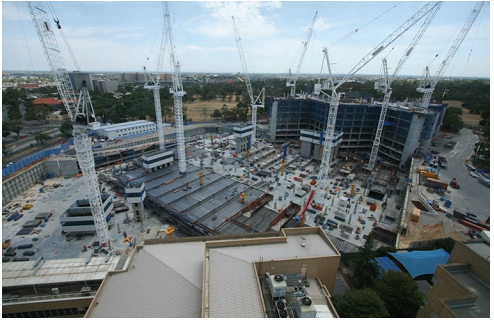
Construction progress on the new hospital in late January, 2009.
_____________________________________________________________________________
1 Victorian Auditor General's Office (2008), 'The New Royal Women's Hospital-a public private partnership', Victorian Government Printer, Melbourne, 25 June.