Key research question: are PPPs a better procurement model?
A key question raised in relation to PPPs is their relative effectiveness compared with Traditional models of procurement. It is commonly expected that the incentives for increased competition and direct consequences of failure contribute to PPP projects being built on time and within budget.
PPP proponents argue that there is greater design freedom, increased incentives to innovate, more opportunity for collaborative work and a more efficient allocation of risk between parties in the PPP model. PPP detractors argue that these benefits do not exist and that there are additional costs associated with PPPs such as bidding costs and complexities compounded by a perceived lack of transparency in the PPP model. Arguably, many of the issues that are seen as plaguing PPPs are also relevant to projects undertaken by governments using the Traditional models of procurement.
As we saw in the review of previous studies, a key question posed in the academic and government research agendas is whether or not PPPs provide a better procurement model than Traditionally procured projects. In short, the simple question that needs to be addressed is:
• Do PPP projects deliver better results in terms of time and cost outcomes in comparison to Traditional projects?
This was our primary research question.
Not unlike the rest of the world, as the PPP market has developed in Australia most evaluations of PPP by researchers in Australia have focused on individual cases, or smaller project pools in order to find empirical evidence in relation to this question. Now that the Australian PPP market has grown and evolved to become one of the world's most
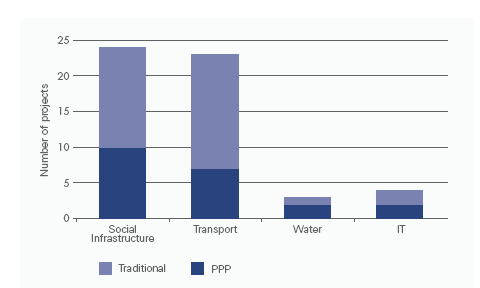
◀ Figure 3.1 Distribution of selected projects for the current study
________________________________________
Source: ACG/University of Melbourne
sophisticated markets, our aim was to address this question with new data and in a more comprehensive fashion than has been attempted in previous studies.