Project stages
Using the four project milestones identified above, we defined the Full Project and three periods in the project lifecycle for analysis, i.e. four different periods over which the relative performance of PPPs and Traditional procurement approaches could be measured and compared. These four periods were:
• Full Project
Original Approval to Actual Final;
• Stage 1
Original Approval to Contractual Commitment;
• Stage 2
Budget Approval to Actual Final; and
• Stage 3
Contractual Commitment to Actual Final.
These four periods are shown graphically in Figure 3.2.
◀ Figure 3.2 Cost over-runs by stages and milestones
_____________________________________________
Source: ACG/University of Melbourne
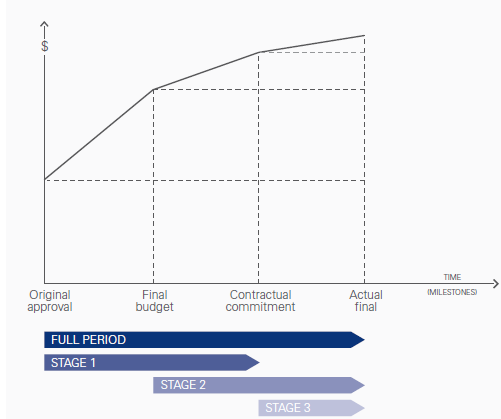
Figure 3.2 shows how the Actual Final cost would be likely to build up in the case of consistent cost over-runs between the milestones. This need not be the case. Since information and commitment by the parties both increase as the stages and milestones progress, it would be expected that the degree of cost over-run would reduce in successive stages. Hence, we should expect to find the greatest degree of cost over-run over what we have termed the Full Period (Original Approval to Actual Final), with the lowest degree of over-run being experienced in Stage 3 (Contractual commitment to Actual Final).
Various periods (stages 1, 2 and 3, and the Full Period) have been calculated in order to provide alternative perspectives on the procurement process, which might be defined differently by different parties. Our interest has also been to examine whether consistent trends can be seen irrespective of the definition of milestones and stages.
In order to address alternative views, cost and time data was obtained at four different milestones in a project, and four different periods were identified. The time and cost data were normalised in order to yield percentage performance relative to the target at each successive milestone or stage. It may be expected that as these stages progressed closer to the final outcome, more information will be known about a project, and outcomes will be closer to those anticipated.