8. Comparative Review of Procurement Methods
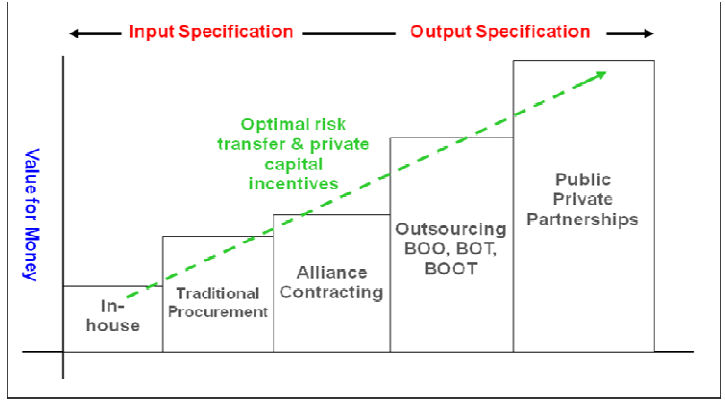
There is sound international evidence that traditional procurement models based on lowest cost evaluation are the worst performing of the state procurement options. Recent studies point to the benefits of private sector participation in the provision and management of economic and social infrastructure. 27 Notwithstanding the difficulties comparing different procurement mechanisms over different time frames and measurement criteria, there is evidence of better procurement outcomes with methods that employ a full or partial output specification, a medium-term management contract and full lifecycle costing (see Diagram 2). The output-specification contracts achieve higher levels of risk transfer, innovation, technology, value for money and improved service delivery compared with traditional procurement.
The major difference between input and output-specified procurement contracts is the optimal alignment of incentives. This is achieved with a combination of financier-led market disciplines, a payment system that balances incentives for over-performance with penalties for non-performance, and the retention of a framework that ensures a high marginal return on investment.
Diagram 1 Comparative Procurement Findings
A comparative study of procurement methods suggests that contracts employing an output specification and lifecycle management significantly outperformed traditional procurement models (see Table xx). The evaluation criteria used in the study included value for money in place of lowest procurement cost, a measurement of incentives, process duration and cost, and both quantitative and qualitative service outcomes. 28 A difficulty here is that comparisons are predominantly based on ex ante evaluation criteria, that is, prior to commencement of service delivery. Operational performance can only be monitored over long service intervals and few PPPs in Australia have sufficient maturity for a comprehensive benchmarking study to produce meaningful results. Nevertheless, evidence from Europe, where there is greater depth and experience in private infrastructure provision, confirms that operational expectations are largely being met.29 User and manager surveys and performance audit reviews are also providing useful evidence of ex post performance and these are now widely employed in the United Kingdom and in the early post-commissioning stages in Australia.
Diagram 2 Comparison of Procurement Methods, 2008
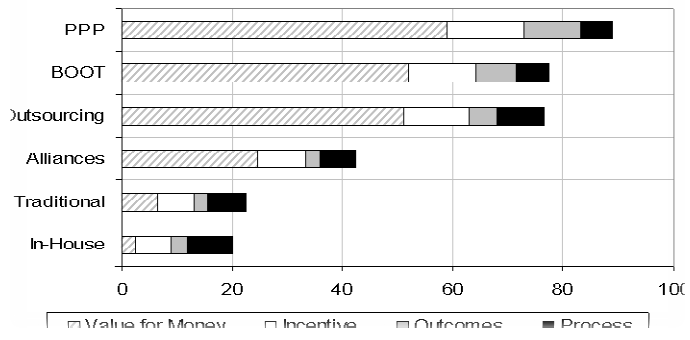
SOURCE: Regan 2008
A comparative review of procurement performance is set out at Appendix A.
__________________________________________________________________________________
27 NAO 2001, 2003a, Mott McDonald 2002, Allen Consulting 2008; Mathias and Reddington 2006; KPMG and BSA 2005; Fitzgerald 2004.
28 The evaluation criteria is based on assessment criteria that included (a) value for money, (b) the role of incentive (c) project delivery cost and timeliness, and (d) process time and cost ( Regan 2008c).
29 European Commission 2004.