2.4 The condition of Victoria's infrastructure
Both economic and social infrastructure is fundamental to a country's standard of living.45 For each dollar spent on infrastructure, economic growth and financial returns are stimulated.
Infrastructure investment stimulates economic growth through job creation, purchasing of goods and services from the private sector and cost savings to industry and the public through projects such as those involving roads, transport and water facilities. Infrastructure projects also enable private companies to achieve reasonable returns on capital for shareholders and investors.
The Committee is aware that a number of academics and studies have suggested that the benefit of infrastructure investment to private industry is undoubtedly positive.46
The Institution of Engineers Australia indicated they were concerned that much of Victoria's infrastructure is barely adequate for current needs let alone future needs; funding commitments are largely inadequate to support the substantial costs of renewal and replacement; and current planning and political processes create a short term focus in an area where a very long term focus is required.47
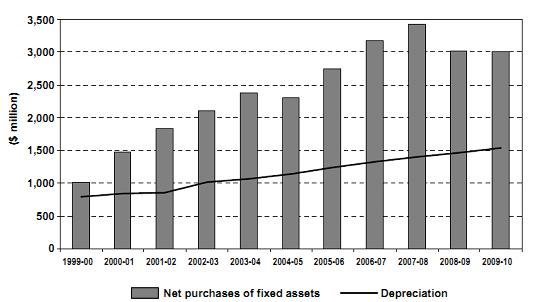
The 2006-07 Budget Papers indicate that since 2000-01, the government has invested about $13 billion in infrastructure, averaging more than $2 billion a year, about double the annual average investment in the previous five years.48
Dr Duffield from the University of Melbourne highlighted that 'the present level of infrastructure funding, from both public and private sector sources, must be raised if standards of living are to be maintained'.49 The Municipal Association of Victoria (MAV) has stated that the local government sector is responsible for over $37 billion of community assets with roads being the single largest infrastructure item.50 The MAV's submission indicated that a limited local government revenue stream and steadily aging infrastructure means there is now a large capital spending deficit on infrastructure items across Victorian local government.51 Private financing of local government infrastructure is still perceived as unchartered territory for the sector, although the Committee is aware that some local governments are interested in pursuing this option.52
There is solid evidence that investment in public infrastructure provides net positive benefits to the community, but this does not necessarily imply that any particular type of infrastructure financing mechanism is better than another, only that investment in public infrastructure yields positive outcomes. Logically, such investments need to be undertaken with minimum financing and transaction costs.
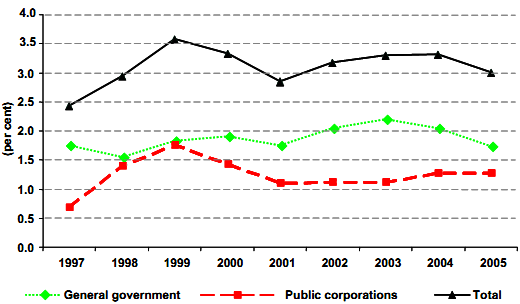
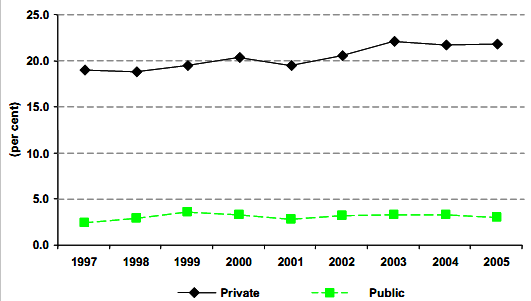
The Committee is aware that the amount of money invested by governments in developing public infrastructure, as a percentage of gross state product, has been declining (exhibits 2.5 and 2.6).
Exhibit 2.5:
Victorian Government capital formation as a
proportion of gross domestic product (GDP) 1997 - 2005
|
|
Source: ABS Catalogue No. 5220.0 - Australian National Accounts: State Accounts 2004-05, Table 8, p.19
Exhibit 2.6:
Victorian Government/private capital formation as a
proportion of gross domestic product (GDP) 1997 - 2005
|
|
Source: ABS Catalogue No. 5220.0 - Australian National Accounts: State Accounts 2004-05, Table 8, p.19
The 2006-07 Budget Papers indicate that since 2000-01, the government has invested about $13 billion in infrastructure, averaging more than $2 billion a year, about double the annual average investment in the previous five years.53
Exhibit 2.7:
Victorian general government sector
net infrastructure investment (a)
|
|
Source: Department of Treasury and Finance, Budget Paper No.2, 2006-07 Strategy and Outlook, p.6
Note: (a) includes purchases of property, plant and equipment and net contributions to other sectors of government less proceeds from sale of property, plant and equipment
The Committee noted the Victorian Government's decision to increase funding for infrastructure. It is important that infrastructure projects are delivered in a cost effective manner, whether through traditional procurement or through a PPP arrangement.
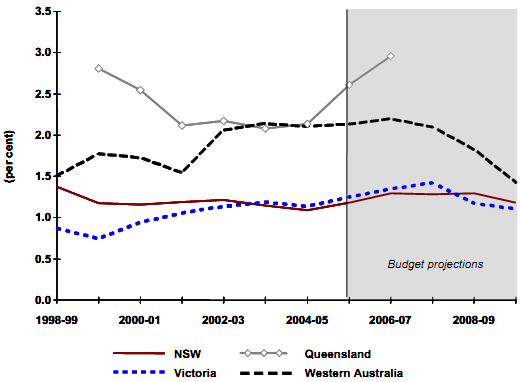
Exhibit 2.8:
Government capital expenditure
as a share of state output
1998-99 to 2008-09
|
|
Source: Compiled by Access Economics using state budget papers
__________________________________________________________________________________________________
45 Dr C Duffield, An Evaluation Framework for Privately Funded Infrastructure in Australia, PhD thesis, The University of Melbourne, 2001
46 For example, Dr C Duffield, An Evaluation Framework for Privately Funded Infrastructure in Australia, PhD thesis, The University of Melbourne, 2001, p.23; and Allen Consulting
47 The Institution of Engineers Australia, 2005 Victorian Infrastructure Report Card, p.vii
48 Budget Paper No. 2, 2006-07 Strategy and Outlook, p.6
49 Dr C Duffield, An Evaluation Framework for Privately Funded Infrastructure in Australia, PhD thesis, The University of Melbourne, 2001, p.39
50 Municipal Association of Victoria, Fact Sheet Council responsibilities, see www.mav.qsn.au, accessed 10 August 2006
51 Municipal Association of Victoria, submission 30, p.4
52 For example, Manningham City Council, submission no.10; City of Whitehorse, submission no.20; Mornington Peninsula Shire Council, submission no.27
53 Budget Paper No.2, 2006-07 Strategy and Outlook, p.6