4.1.6 Partnerships Victoria policy framework
The eight objectives and nine principles underpinning Partnerships Victoria were outlined in chapter 2. These objectives and principles covered an array of policy objectives, project management practices and process requirements and appear somewhat confusing.
Focusing on the government's high level policy objectives, Partnerships Victoria intends to:
• maximise the level of infrastructure;
• promote growth and employment opportunities in Victoria;
• deliver significantly improved services; and
• maximise the social and economic returns of government expenditure.
Each of these policy objectives is underpinned by:
• ensuring best practice in infrastructure provision;
• encouraging innovation;
• articulating accountabilities for outcomes;
• passing benefits on to customers, business and communities
Several of the principles underpinning Partnerships Victoria aim to clarify what is being pursued by government. They focus on specifying the end result, the best outcomes in allocating risks, the establishment of transparent performance measures, and the provision of incentives to encourage high level performance.
Several principles also specify that the Partnerships Victoria process should ensure government approval of projects; adopt competitive tendering processes; emphasise transparency and disclosure; seek to ensure confidence in the probity of the partnership model; and minimise transactions costs through the use of standardised approaches where possible.
The Department of Treasury and Finance advised the Committee that further principles of the policy aimed to ensure government retained responsibility for the delivery of 'core social services' while the provision of public infrastructure and related ancillary services were not retained.91 Thus, the private sector may provide and operate infrastructure while core services (such as teaching in government schools or providing clinical services in hospital) will be provided directly by the government. Treasury and Finance stressed that value for money must be demonstrated under the Partnerships Victoria policy.92
The Department of Treasury and Finance indicated that 'generally, full government funding will be allocated for non self funding projects before market interest in a PPP is formally sought'.93 Projects having a net present value of at least $10 million, but more likely $25 to $30 million for most types of projects, are likely to have the most potential for Partnerships Victoria treatment.94 The policy was seen by Treasury and Finance to be applicable to a range of partnership models and over a variety of commercial scenarios. The department also indicated that a rigorous process had been designed involving 'a transparent tendering process and focus[sed] attention on upfront planning work such as the output specification, commercial issues and resources allocated to the project'.95
Exhibit 4.1 outlines the nine steps in a Partnerships Victoria project, from conception to implementation.
Exhibit 4.1:
Major stages in developing a Partnerships Victoria project
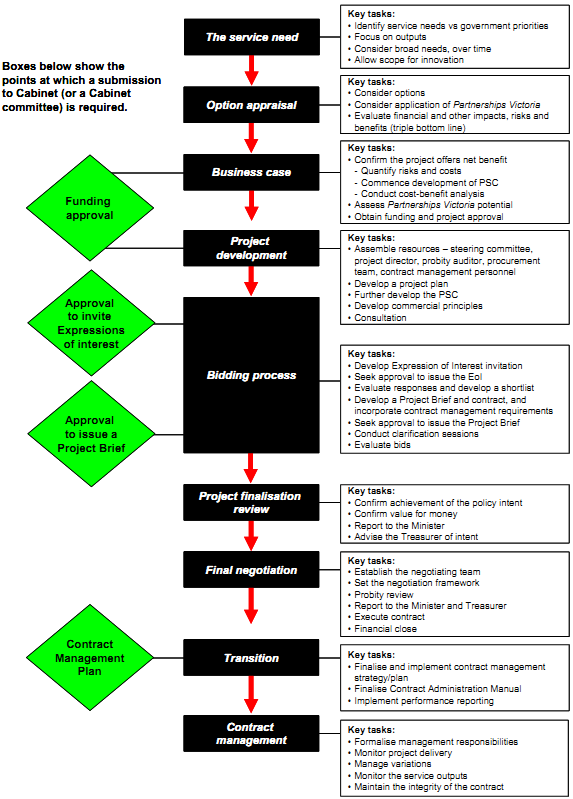
Source: Department of Treasury and Finance, Partnerships Victoria Guidance Material, Overview, July 2006, p.15
Target figures specifying the proportion of infrastructure spending likely to be pursued in future through the Partnerships Victoria policy do not appear to have been formally set, although the Treasurer announced that the current proportion is around 10 per cent of the government's annual capital asset investment, although this may range anywhere from 5 per cent to 20 per cent depending on the particular year.96
In response to a recommendation in the Fitzgerald report that the bidding process be streamlined with a view to reducing the cost of tenders and encouraging more bidders to participate, the Department of Treasury and Finance released in February 2006 three proposals to reduce bid costs:97
1. developing a departure schedule instead of marked-up contracts;
2. ranking evaluation criteria in the project brief;
3. presenting the public service comparator early in the bid phase.
Following comment from industry groups, the Department of Treasury and Finance advised that the status of these proposals is:98
• the Partnerships Victoria interactive tender process advisory note is being updated to include a PSC presentation and other changes to improve the depth and scope of interaction between government and bidders. The aim of this presentation is not to disclose the detailed costings of the PSC, rather to further clarify the government's expectations. The revised advisory note will be finalised shortly;
• the introduction of standard contract clauses will be completed during 2006-07. The use of departure schedules will also be considered as part of this exercise as industry groups have emphasised that these initiatives should be considered jointly;
• other initiatives, such as the mapping of evaluation criteria to submission requirements and streamlining bid submission requirements are being considered and will be rolled out on a project to project basis.
__________________________________________________________________________________________________
91 Department of Treasury and Finance, submission no.35, p.9
92 ibid, p.10
93 ibid.
94 ibid.
95 ibid., p.11
96 Hon. J Brumby, MP, Treasurer, A national approach to PPPs - The importance of creating a 'single market' appearance to gain global attention: Australia's experience' speech given at the 13th annual conference on Public Private Partnerships 2005 conference, 28 November 2005, Toronto, Canada, p.4
97 Partnerships Victoria, website, www.partnerships.vic.gov.au, accessed 8 August 2006
98 S Schinck, Director, Strategic Management, Department of Treasury and Finance, email, 27 September 2006