2.1 Identifying capital works needs
Agencies are responsible for delivering particular services in line with the Government’s overarching service delivery goals and priorities and for ensuring that they have the necessary physical assets/infrastructure to achieve these goals.
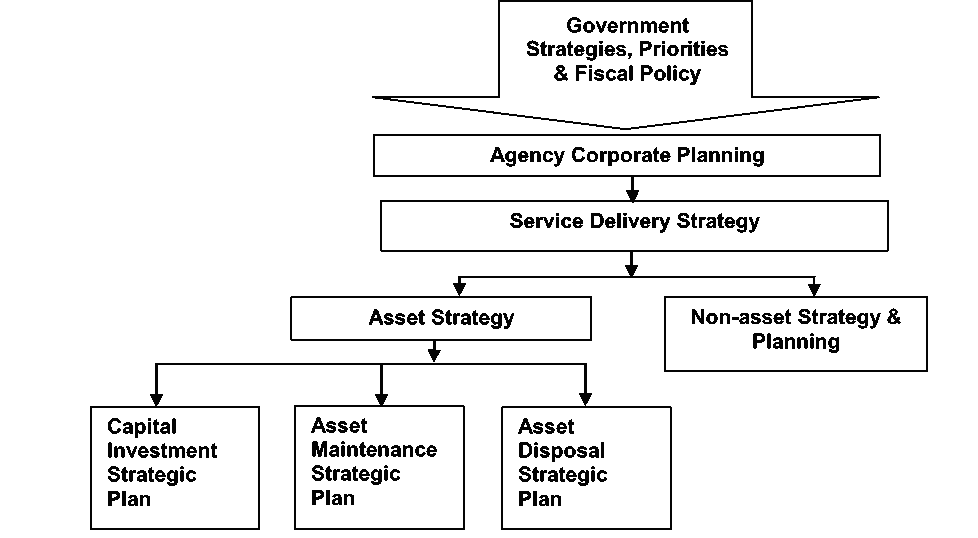
Agencies should undertake their asset/infrastructure planning within the Government’s Total Asset Management (TAM) framework10. Through TAM planning, agencies should develop an Asset Strategy which identifies the assets required to sustain appropriate service delivery levels and how those assets should perform.
Where an agency’s Asset Strategy indicates that existing assets are insufficient to sustain appropriate service delivery levels, new capital works may be considered as a cost-effective option for service delivery. The agency should include its requirement for new capital works in its Capital Investment Strategic Plan (CISP), with links to the other TAM Plans for Maintenance and Asset Disposal.
The CISP is a ten (10) year rolling planning document, with detailed project plans for the upcoming Budget year and the next three (3) years, and a longer-term projection for the next six (6) years.
An agency must construct its CISP to ensure that its asset portfolio meets its required service delivery outcomes, now and in the future.
Agencies should follow these steps (Figure 2.1):
• Define their service/business outcomes, and ensure that these are consistent with the Government’s goals, strategies and priorities, such as transport and metropolitan and regional development. They should examine opportunities for collaboration and integration of their strategic planning with that of other agencies, where this will lead to better service outcomes for the community
• Consider what services are required and how these can be delivered sustainably within existing resource limits
• Consider demand management and non-build or less asset-intensive solutions to improve the efficiency and effectiveness of service delivery strategies
• Examine opportunities to improve the performance of their existing asset/infrastructure base (portfolio). They should ensure that assets align with service/business needs, asset-related risks to services are monitored and managed, existing assets are properly maintained, and surplus assets are appropriately divested
• Identify in so far as is practicable the performance (outcomes) based requirements for the infrastructure needed to sustainably support agreed service/business outcomes. Generally, these requirements would include social, environmental and economic parameters.
• Identify financing options for asset management projects and programs.
Agencies should only plan new infrastructure investment if the assets are vital for the selected service delivery method and resources are likely to be available.
Figure 2.1 Agency Strategic Asset Planning Hierarchy
______________________________________________________________________________
10 More details on the Government’s Total Asset Management (TAM) Policy and Guidelines are available at Treasury’s Website: www.treasury.nsw.gov.au. Whilst State-owned corporations are not bound by TAM policy, their asset strategies should as far as practicable be consistent with the principles of TAM.