Choosing the Right Delivery Model
| Key Questions • How confident are you now about the type of infrastructure and services that are needed over the next 10, 15, or 20 years? • How likely is it that the needs of citizens in this area will change? • How likely is significant policy change? • How easy is it to specify what will be needed? • In which sector is the PPP approach going to be employed? • How confident are you in the supplier of the service and how much control do you wish to retain? • Can risks be transferred or would better outcomes be achieved through risk sharing?
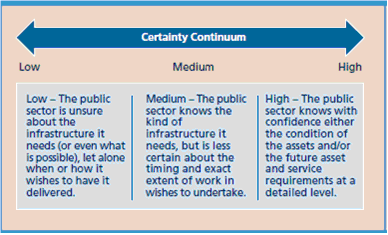
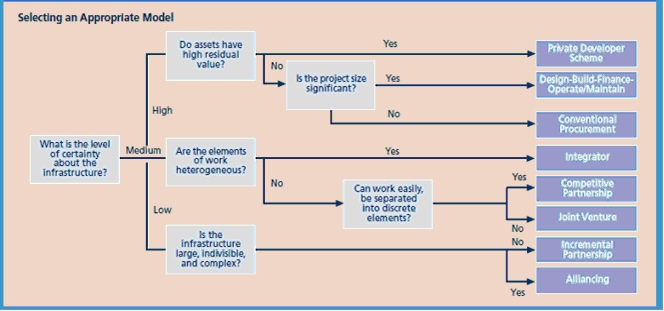
The level of certainty the public sector possesses about its infrastructure and service requirements should be a key determinant in the choice of model. This includes certainty about the external environment, including the policy environment, as well as the capacity of contract performance standards and realities and incentives to higher outputs. A high level of certainty suggests that the government can shift substantial control and risk to the private sector (the best options are Private Developer Scheme, Design-Build-Finance-Operate/Maintain, or Conventional Procurement). The integrator, joint venture, or competitive partnership models should be considered where certainty is more limited. The alliancing or incremental partnership models would be more appropriate when a low level of certainty exists. The decision tree below provides some guidance regarding the most appropriate model in certain circumstances. This list of models is by no means exhaustive; any decision to choose one model over another should always be derived from a robust appraisal of the options, based on the specific circumstances in which the project is being developed.
Source: Building Flexibility: New Delivery Models for Public Infrastructure Projects, Deloitte Research, 2005. |
Alliancing. Where uncertainty about the nature of the infrastructure or services required to meet project objectives is irresolvable (unknown technological risks, for example), using an alliancing model can allow projects to go forward. Alliancing is a term used to describe delivery models in which the focus is on encouraging close collaboration between the public and private sector through the use of payment mechanisms that ensure that the interests of all parties are aligned with the project objectives. The aim is to avoid the adversarial relationships and acrimony that sometimes characterize more conventional procurement models, and instead seek to ensure that all parties work together collaboratively for the good of the project. This model can be particularly useful in the defense sector, where projects can be large and indivisible and where well-defined outputs are often precluded from the outset.
The Dutch have frequently used alliancing in economic development projects. Such projects often have diverse output requirements (a specific number of social and affordable housing units, designated areas for public space and community centers and a target level of growing economic activities and traffic flow, among others) that require expertise and resources from various public and private partners in order to meet project objectives and share risks. The alliancing model connects flexibility to effective project implementation to overcome the challenge of joint delivery.
Bundling. For smaller projects, traditional PPP processes can be particularly costly when weighed against the project's modest revenue streams. This high cost can deter possible private partners from bidding if they feel future revenue is unlikely to outweigh transaction costs. Bidding on building individual hospitals, for example, requires substantial investment but presents relatively small returns compared to the expense of construction and maintenance.
One way to address this problem is by bundling together several projects. By contracting with just one partner to provide several small-scale projects, the public sector can reduce the length of the procurement process as well as transaction costs. In Australia, bundling sometimes takes the form of grouping hospital construction with ancillary structures and commercial activities, thereby creating enough revenue generation to balance against building and procurement costs. Bundling has also been used in Ireland to reduce the problem of disproportionately high transaction costs relative to the capital value of building new schools.
Incremental partnership. Another option for smaller projects is an approach termed incremental partnership. Under this model, the government enters into a framework agreement with a private sector partner that procures the necessary infrastructure and services on behalf of the public sector. As its requirements become clearer, the government agency can "call off," or stop specific projects if they appear unproductive. The private sector partner competitively procures the services and infrastructure from subcontractors but retains overall responsibility for service levels as assessed against clear performance measures. There is no exclusivity for the private sector partner-the public sector retains the right to use alternative providers if it wishes. This avoids the weaknesses associated with "big bang," large-scale contracts that are difficult to reverse and require a long-term commitment from both parties.
The main point in introducing these models is to illustrate that no single approach addresses all infrastructure issues. Rather, a continuum of delivery models is available to accommodate varying degrees of risk and reduce both transaction costs and procurement time. This range will continue to widen as the field evolves. In the United States, for example, tax-exempt private activity bonds (PABs) and a more lenient regulatory environment are likely to catalyze innovation in delivery models. As experimentation with new innovative partnership models continues, the old way of approaching procurement as an "either-or" decision will continue to give way to new hybrid models that can help meet these challenges.