Water and Wastewater
Water and wastewater management, traditionally the province of state and local government, represents another fast-growing area for PPPs. Many countries have started to use PPP structures to privately finance needed investment in these sectors.
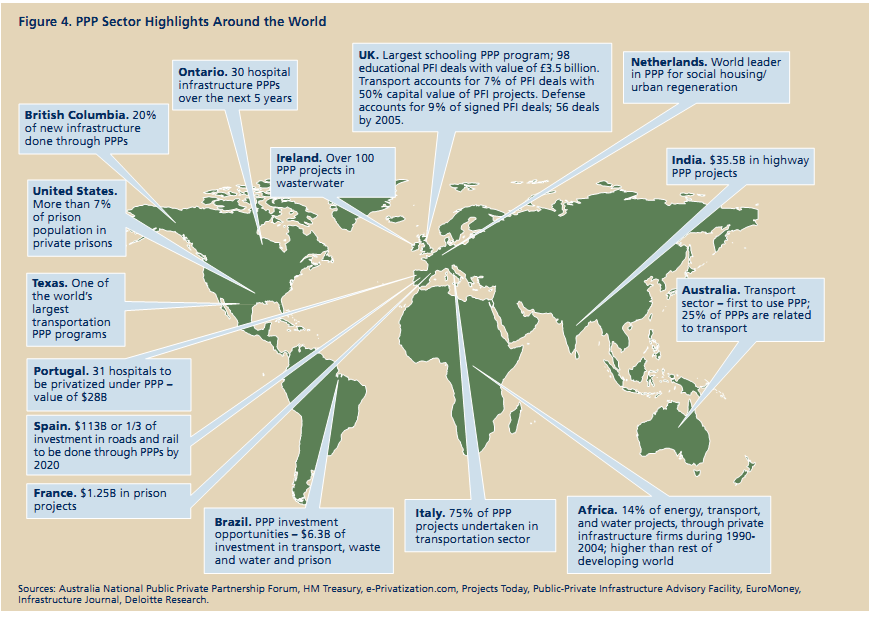
The total value of water and wastewater PPP projects in the Australian states of Victoria and New South Wales is approximately $131.5 million.47 With aging water and wastewater systems demanding more than $28 billion for renewal, many Canadian municipal governments have also begun to consider alternative financing mechanisms to deliver water service.48 In the 1990s, a few pioneering municipalities such as Moncton, Hamilton, and Dartmouth initiated Canadian PPP projects.49 Meanwhile, in Ireland, more than 100 water and wastewater PPP projects (most of them designbuild projects) are either operational or in construction and planning.
The largest European water PPP is in the Netherlands, where the Water Board of Delft land awarded a 30-year concession, with a total contract value of €1.58 billion. The project includes the design, construction, and operation of a new wastewater treatment plan and, to comply with more stringent discharge requirements, the refurbishment and operation of an existing wastewater treatment plant.
Water and Wastewater PPPs: |
Challenges and Solutions |
Challenges |
Substantial procurement costs. High procurement costs and high uncertainty about the availability of technology require a contractual framework with shorter procurement times that fosters innovation. |
Uncertainty. The condition of assets in existing facilities may result in an increase in project costs. |
Scale. The size of the project may not allow for efficient use of private finance. |
Politics. Water and wastewater are often seen as falling squarely under the public sector domain. Public employees may have deep concerns for their welfare under the new management. |
Solutions |
Thinking creatively about the best financing and delivery model can help overcome some of the challenges in this sector. For example, governments can reduce the length of the procurement process and attract companies with stronger financial and operational capacity by using a bundling approach. This saves procurement time and effort as the public sector is no longer required to contract with different private partners in delivering individual small-scale projects. |
A key challenge in this sector is that the consumer is generally not exposed to the full cost of water. Moving to full cost pricing of water utilities before moving to a PPP approach can help to avoid rate shocks that may derail the project. |