P3 Models
There is a broad spectrum of possible models that could be considered P3s, although there is not universal agreement on all models. Design-Build (DB) is a model in which the private sector designs and builds infrastructure to meet public sector performance specifications, often (though not necessarily) for a fixed price so the risk of cost overruns is transferred to the private sector. Many do not consider DB's to be within the spectrum of P3s and DB's would not fall under the proposed definition for The City.
The following terms are commonly used to describe partnership models in Canada that would be considered P3s under The City's definition, although this should not be considered a definitive or complete listing3:
■ Operation & Maintenance Contract (O & M): A private operator, under contract, operates a publicly-owned asset for a specified term. Ownership of the asset remains with the public entity.
■ Design-Build-Finance (DBF): The private sector designs, finances and constructs a new facility under a long-term lease. The private partner transfers the new facility to the public sector at the end of the lease term.
■ Design-Build-Finance-Operate (DBFO): The private sector designs, finances and constructs a new facility under a long-term lease, and operates the facility during the term of the lease. The private partner transfers the new facility to the public sector at the end of the lease term.
■ Build-Own-Operate (BOO): The private sector finances, builds, owns and operates a facility or service in perpetuity. The public constraints are stated in the original agreement and through on-going regulatory authority.
■ Build-Own-Operate-Transfer (BOOT): A private entity receives a franchise to finance, design, build and operate a facility (and to charge user fees) for a specified period, after which ownership is transferred back to the public sector.
■ Buy-Build-Operate (BBO): Transfer of a public asset to a private or quasi-public entity usually under contract that the assets are to be upgraded and operated for a specified period of time. Public control is exercised through the contract at the time of transfer.
■ Operation License: A private operator receives a license or rights to operate a public service, usually for a specified term. This is often used in IT projects.
■ Finance Only: A private entity, usually a financial services company, funds a project directly or uses various mechanisms such as a long-term lease or bond issue.
The names of the various models indicate the scope of the services that are bundled together under each structure. These models distinguish between operating and maintaining the infrastructure. In terms of P3 models, the difference between maintain and operate is that maintain restricts the role of the private partner to physical maintenance of capital asset (e.g. a fire hall), but does not have the private partner delivering programs, products, or services (e.g. firefighting) to the public or The City. The appropriateness of a P3 model, particularly operate versus maintain will vary with each project. The different arrangements therefore result in varying degrees of risk and responsibility that the private sector assumes, as shown in the following figure:
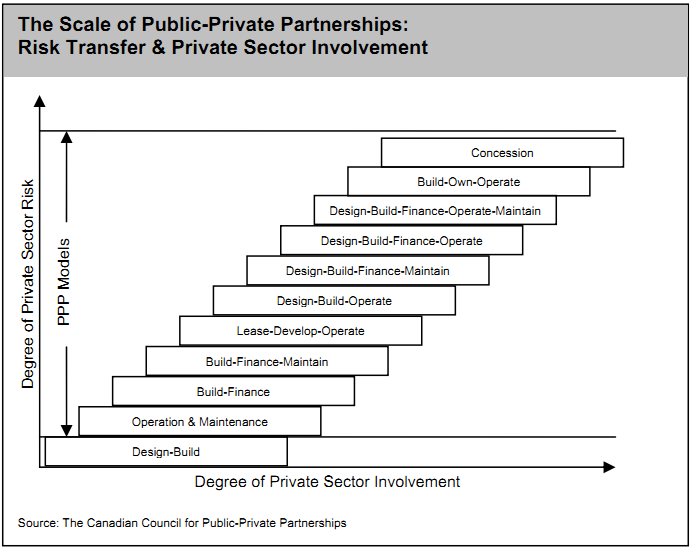
_______________________________________________________________________
3 Canadian Council for Public-Private Partnerships.