Assessment of options
A comprehensive study of other available options was not undertaken. As other noted in the post implementation review, the appraisals that DET conducted did not always document the capacity or availability of existing public schools to cater for demand, although the business case for the second contract did look at the impact on surrounding schools of doing nothing. This makes it difficult to assess whether or not the appraisals adequately considered demand management, non-construction strategies or opportunities to improve the performance of existing public school facilities.
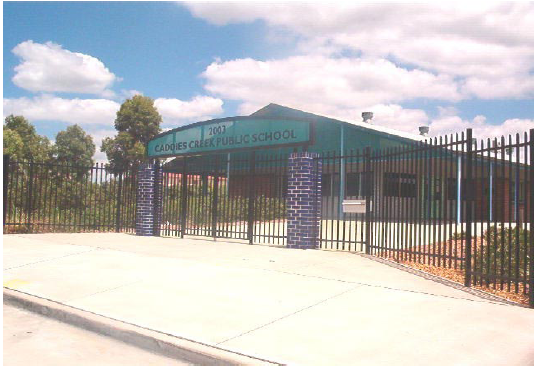
Caddies Creek Public School opened in 2003 using traditional procurement
In 2005, prior to the second contract, DET partly redressed this by retaining a consultant to examine four alternative procurement models:
1. private sector construct; public sector financed; public sector design and delivery of non-core services
2. private sector design, develop and construct; public sector financed; public sector delivery of non-core services
3. private sector design, develop, construct and maintain (for 4-6 years); part private sector financed; public sector delivery of all other non-core services
4. privately financed project and private sector delivery of some/all non-core services.
These models were qualitatively (although not quantitatively) assessed. Confirming earlier advice, the consultant concluded that:
■ demand risk (such as related to the future school population) remains with the State under each of the procurement models
■ models 3 and 4 are 'packaged approaches' and arguably allow DET to concentrate on the delivery of the educational curriculum, without having to worry about the delivery of services
■ model 4 offered the greatest potential for value for money from innovation and the greatest whole-of-life affordability.
However, in the absence of a comprehensive financial and economic analysis of the alternative procurement methods for provision of school facilities - as with the public sector comparator analysis of traditional procurement (described in section 3.5) - it is not possible to judge whether the New Schools Project could not have achieved similar results using a different procurement route. There are major benefits from the PFP approach in areas of risk allocation, effective project management and an enhanced focus on quality of service. But while such benefits may be strongly associated with PFP procurement, they are not necessarily unique to it. In section 3.5 we recommend use of the information and method of the public sector comparator to better examine other alternatives.