Driving innovation
Private sector innovation is often cited as a key value driver for selecting a PPP approach over the traditional model. Our survey captured varied opinions on the degree of innovation achieved on the early PPPs.
|
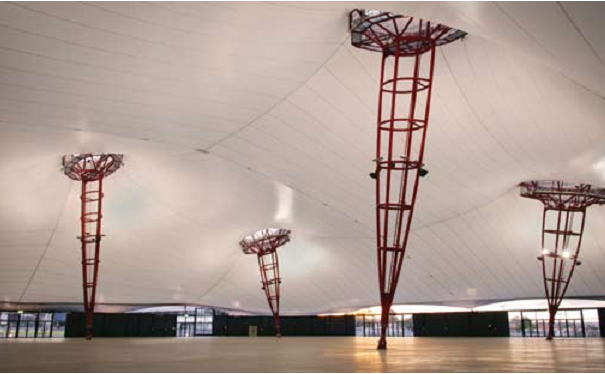
| "The process helped the Royal Agricultural Society to carry out some deeper analysis of how the Show functions to provide an improved service to patrons. This contributed to some radical and exciting innovation in design." John Rickard, Victorian Department of Primary Industries |
|
| |
|
|
Participants from the Southbank TAFE PPP are positive about the impact of innovation in facilities design. Geoff Barnsley, Executive General Manager Operations, Spotless, notes:
"Innovation was demonstrated through the flexibility of space and resources. Historically TAFEs have struggled with adapting accommodation to meet the variety of class configurations and technical content taught at the college. The design of the new space was testament to innovations developed with assistance from the private sector."
Norm Jagger, Project Director for Queensland Southbank Institute of TAFE, also recognises innovation in managing the construction phase:
"One of the advantages from the PPP framework has been minimal disruption to normal operations. Traditionally during the construction phase, buildings would have been closed and students relocated to another campus. However, the private contractors have worked around normal operations to do what they can to minimise disruptions."
The PPP process has also driven innovation from fresh thinking on the part of the procuring agency as John Rickard, Contract Director, Victorian Department of Primary Industries, highlights:
"The process helped the Royal Agricultural Society to carry out some deeper analysis of how the Show functions to provide an improved service to patrons. This contributed to some radical and exciting innovation in design."
By contrast, other participants observed little innovation outside of project requirements:
"The project achieved some innovation, but not materially different to that which would have been achieved under traditional procurement." Trevor O'Rourke, Director Corporate Services, SA Courts Administration Authority.
"In the first NSW Schools PPP, there was a request to pursue greater freedom of design. However, to meet the extensively reviewed school facility standards and cost effectiveness, few design innovation opportunities were pursued. For the second PPP, the design imposed the New South Wales facilities standards, providing surety of function and minimising design risk for the consortia." Terry Whyte, Project Director, NSW Department of Education."
The survey revealed innovative asset solutions are more likely when the PPP contract bundles a wider range of services. This allows the private sector to consider innovative ways of creating efficiencies by taking a holistic approach to delivering facilities and services. Social infrastructure projects with only a limited range of services constrain the potential for innovation. For example, recent hospital PPP projects in Australia have missed the opportunity to drive innovation by extending services to clinical ancillary areas such as pharmacy and diagnostics.
Interviewees raised the issue of limited incentives for innovation during the operational phase of a project. The standard PPP procurement model is designed to encourage innovation at the tender stage. However, small operational improvements beyond the scope of the tender could create greater efficiencies in the long term. The nature of facilities management sub-contracts can sometimes make the private sector reluctant to invest in more innovative delivery methods than were prescribed in the original bid.
"Incentives in facilities management contracts can conflict with the longer term benefits of life-cycle maintenance. Facilities managers might minimise FM costs in the short term to the detriment of life-cycle maintenance where there is incentive to do so" John lliadis, Contract Administrator, Casey Hospital.
Procuring agencies and their advisors continue to determine how best to stimulate innovation throughout the term of the contract. Some argue that the current contracts provide for flexibility and technical refresh through change clauses that account for minor works. However, the problem has yet to be solved in terms of creating the right commercial incentives. For example, if a PPP hospital is to take advantage of technological advancements such as mechanised drug dispensing, then the contract needs to include a commercial mechanism to reward the provider appropriately for refreshing technology.
Moving forward, governments should seek to improve on commercial incentive structures to encourage innovation, rather than having to rely on a change mechanism, where the private sector is motivated by reward from taking commercial risk.
Royal Melbourne Showgrounds image provided by Victorian Department of Primary Industries