2.3. CAPACITY-BUILDING
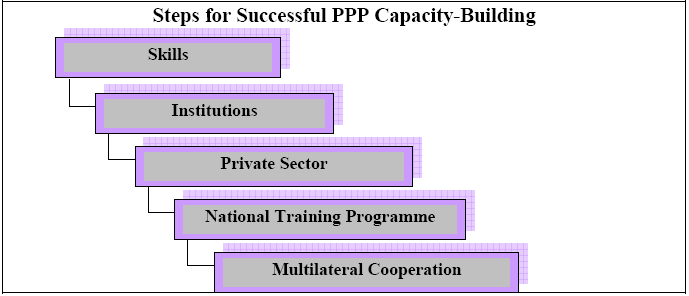
Skills, Institutions and Training
GOVERNANCE CHALLENGE PPPs involve complicated structures that require new skills, which are found more in the private than the public sector. How can Governments find the necessary skills to develop PPPs? |
Principle 2 - Governments can build the necessary capacities in a combined approach which establishes new institutions and trains public officials while at the same time using external expertise.
Developing skills inside governments presents a major challenge …
There are a number of new skills that must be developed for PPPs, such as negotiation, contractual and financial skills. One of the key challenges is that instead of the traditional approaches, which focus on inputs, PPPs require skills that can identify the outputs of projects.
This involves fixing specifications and targets that the private partner has to attain in order for the payment to be made and to monitor the performance of the partner and foresee any risks that threaten the delivery of the project. Civil servants furthermore will need to understand the industry from which the government will seek partners.
These skills are generally not found within governments and it is therefore best to bring private sector experts into the government.
These new financial and legal skills may be acquirable, but there also needs to be acceptance and willingness by the public sector of the added value which private companies running public assets can bring. This is even more difficult as these new arrangements can be perceived as a threat to job security by public sector employees.
…As ways must be found to put the skills into new institutions.
It is extremely difficult for a government department to switch virtually overnight from the status quo where it has acquired an asset through traditional procurement to managing a network of different agencies involved in the building of and design of a project over a long period of time - the characteristic features of PPPs.
PPP Units / Task Forces should be established to house the new skills. This concentration in one body will increase the impact of the acquisition of these skills.14
Table 2. Steps for Successful PPP Capacity-Building
This must be done by establishing a project pipeline…
The key role of the PPP Unit is to help develop and intelligently support the management of the project preparation process - an area where most governments have little expertise. It is important to carefully prepare and develop projects, especially given the long-term contractual nature of many PPP deals and the scrutiny they will subsequently be subject to by lenders' credit committees and the public.
…Supporting regional PPP units…
Typically, in larger countries the national PPP units will not undertake the projects but rather provide the policy, technical, legal and other support mechanisms to local authorities and government ministries that have the responsibility of putting the project together. Practically, it can help the relevant procuring authority (particularly one that is new to PPP or if the project is particularly new or complex) more confidently manage the whole process (including external advisors) from the development of the initial project design through to the bid evaluation process and post financial close. Units can achieve this by, for example, providing experienced people to sit on the decision-making boards for individual projects and supporting the public sector at key decision-making points.
…Facilitating the PPP process…
The National PPP Unit should also reduce bid times and costs and improve the quality of the PPP procurement process with standardized contracts and procedures, while ensuring national-level consistency. It can consult with investors and communicate to line ministries their concerns regarding legal and institutional bottlenecks to the implementation of PPP projects. It can furthermore develop the market for PPPs which can provide a consistency of approach across a wider range of projects - thus limiting the chance that the private sector might play one part of the public sector off against another (e.g. the development of the standardized contract in the UK, with sector specific standard derogation, which has helped significantly here). This also reduces the time and cost incurred by private sector bidders to learn/accept new rules for each separately administered market (another benefit of standardization).
…And providing leadership of the PPP programme.
The national PPP unit needs to be in a position to lead the programme from the front, while also having its own clear ideas on programme management. It must also have developed its approach to managing advisors, and for engaging with the contractors, service providers and providers of long-term debt and equity finance.
To provide this leadership capacity it is important to be able to recruit highly qualified staff and to take the steps necessary to keep them. Because of the higher salaries it offers, the private sector can drain the public sector of its best personnel. Hence, to ensure that the PPP unit can provide the leadership, government should design structures to counter the risk of an internal brain drain and ensure that PPP programmes will receive resources to be run properly. The consequences of not doing so can be much more costly in poorly prepared and managed projects.15
It is also essential to build capacity by developing the market…
PPP units should maintain a strong dialogue with all players in the market. This often starts purely as a need to liaise over PPP technicalities and to provide the private sector with information. The role usually develops because the unit reports to colleagues and Ministers the key findings about market attitudes and companies' responses to public sector actions and statements, in addition to reporting details and views about the private sector's capacity.
Moreover, the PPP unit can hold regular seminars for the commercial advisers - legal, technical and financial. Advisers play a central role and they can facilitate dialogue between the public and private partners in accordance with government policies and technical guidance. They also give the unit considerable support and advice informally. The PPP unit will be invited to speak at events sponsored by various players - construction companies, banks, etc. - to provide information. The PPP unit will invariably invite all the main players to 'one-to-one' meetings for discussions about their strategies and plans.
…But doing so at arms length…
However, while it is important that the PPP unit engages with the business community in establishing partnerships, it is important that the PPP unit retains its neutrality and independence from the private sector and ensures that it projects the public interest and operates according to the values and principles of the public sector.
…And keeping the programme accountable for its performance.
The institutional infrastructure requires bodies that can independently scrutinize projects after they have been signed in order to determine whether or not policy objectives have been met. This is not a role for a PPP unit but is vital as a source of independent and technically competent review of projects, which can be used to feedback into further development of policy and guidance.
Partnerships UK (PUK) PUK is one example of a PPP Unit that encapsulates many of these principles. PUK was formed in 2000 to succeed the Treasury Taskforce in providing department-wide centralized support. This allowed the Treasury to concentrate on developing PFI policy, while setting up a separate centre with the expertise to help procuring authorities on more specific transaction-related and day-to-day issues. Hence PUK has a specific public sector mission set out as: 'to support and accelerate the delivery of infrastructure renewal, high quality public services and the efficient use of public assets through better and stronger partnerships between the public and private sectors'. As a Public-Private Partnership itself, PUK has a 51% private sector equity ownership, with HM Treasury and the Scottish Executive making up the remaining share. PUK has around 50 professional staff, many retained for more than five years. With over 600 signed projects, the majority of which are moving into or already in their operational phase, the UK has also looked to provide greater support to projects as they make their transition from procurement to the operational stage. An Operational Taskforce acting on behalf of the UK Treasury was created within PUK to work to this effect. The Operational Taskforce is a source of support, guidance and advice for operational projects, advising on contract management strategy, market testing, contract variations and a host of other PFI related issues. |
Developing national PPP training programmes can also bolster the development of PPPs…
The PPP unit will establish national PPP training programmes to build the expertise of government officials. A national training programme that has a greater chance of success should include practical 'on-the-job training' as opposed to theoretical classroom lecturing. In addition, by taking an incremental approach, setting and then following international standards, perpetually pursuing new knowledge of PPPs and being trained by country-specific PPP educators, developing good governance best practices through case studies, and engaging in on-site project learning, national training programmes increase their chances of success. Overall, "training by doing" inside the operational environment may provide the best solutions for PPP education.
Examples of different types of national PPP training programmes: Spain: SEOPAN, the association of major Spanish contractors and concessionaire groups, has established with a local management-training institute an MBA programme that has produced students to work in the field of concessions. Netherlands: Within the Ministry of Transport a number of large PPP projects have been brought under the supervision of a single management entity and a PPP Knowledge Pool was established on 1 September 2006. The purpose of this Knowledge Pool is to consolidate, develop and spread financial, economic, legal and contractual knowledge and expertise in the area of PPPs within the Ministry. The Knowledge Pool is dedicated internally to facilitate the key positions in the different PPP projects. The rationale is to build expertise on the basis of delivering a few successful pilot projects, which reflect the Ministry's new orientation in PPPs towards reliable and predictable access of transport services. United Kingdom: Partnerships UK runs one or two times a year a PPP Foundation Course specifically for public sector PPP task force officials involved with the development and management of PPP programmes. |
…Foster multilateral cooperation…
Multilateral cooperation is important in PPP training programmes because it saves resources and avoids reinventing the wheel each time a country launches a PPP programme. National PPP units in this regard have helped other governments to establish their own units and to help with training on a bilateral basis. Gradually, over time, a consensus has emerged that there is a need now to make such valuable ad hoc arrangements more formalized in a new multilateral framework of cooperation.16
…And at the same time combine this with the hiring of external advisers to fill the skill gap.
For countries getting started in PPPs, a key requirement is to provide the necessary skills, usually by hiring consultants and external advisers. As it stands today, certain countries issue guidance on the hiring of consultants as advisers to PPP projects and it is essential to bring advisors into the project early rather than incorporating them into the team at a later date. In particular, the right advisors can provide the following guidance:
(a) Technical
(b) Legal
(c) Financial and
(d) Project Monitoring/Due Diligence.
It is important to ensure that only credible advisors with relevant experience are hired, while setting clear and binding rules of project governance, putting sufficient control mechanisms in place, and developing standard contract guidelines in order to maintain a seamless integration of the external advisers within the relevant government department.
ACTION POINT Training is a critical component for a successful PPP programme and following the dissemination of the Guidebook, it is proposed, at a next stage, to elaborate training modules for project specific PPPs such as in roads, hospitals and schools. |
Sources and Further Information
(i) Deloitte and Touche, Closing the Infrastructure Gap, Global Addition, 2006.
(ii) PriceWaterhouseCoopers LLP, "Delivering the PPP Promise", November 2005.
_____________________________________________________________________________________________________
14 PPP Units can also be located within special ministries, e.g. Transport, Health, and Education etc., sometimes functioning in coordination with a central unit under the auspices of the Ministry of Finance. In the UK, for example, a number of operating ministries, such as in health, have their own PPP units.
15 A key point is that Governments can often find it hard to recruit and retain PPP talent (compared to the private sector) because of: (i) rigid or formal recruitment systems (with limited secondment from the private sector, and limited lateral entry into civil service positions); (ii) frequent intra-departmental transfers and lack of specialists; (iii) salary differentials with private sector (which not only hinder recruitment of experts but also lead to departure to the private sector of public officials with valuable PPP experience and expertise).
16 The European Commission, jointly with the European Investment Bank, is establishing a European PPP Expertise Centre (EPEC), to be a platform to exchange experience about PPPs and to help develop PPP policies where Member States or responsible public authorities at regional level require such support. It is proposed that this body will become operational in 2008.